
Taylor Swift's Vanity Fair Profile 'The Mastermind', Explained: What It Says, What It Doesn't Prove
By MyQuickTrippers Editorial Team · 27 Nov 2026
10 min read · Culture & Heritage
Vanity Fair published a profile of Taylor Swift on Monday 23 November 2026 that never once uses her name. Titled “The Mastermind” and written by May Jeong, the piece calls its subject “The Star”, gives Travis Kelce the codename “Redwood”, and draws on interviews with more than 100 people, according to the magazine. It has dominated entertainment news ever since — not because of what it proves, but because of what it claims. This guide explains what the profile actually says, who said what, and what it does not prove. One rule governs everything below: every allegation in the piece is a claim from the magazine’s sources, many of them anonymous. None of it is established fact, Swift declined to answer the magazine’s questions, and she has made no public statement about the profile as of Thursday 27 November 2026.
The profile was commissioned in autumn 2025 and built around a simple device: Swift is never named. She is “The Star” throughout, and the people around her get codenames too — Travis Kelce is “Redwood”. The writer, May Jeong, said she interviewed more than 100 sources for the piece, including former classmates, teachers and music-industry figures. The article is structured like a record, with a Side A and a Side B presenting contrasting views of the same person.
That structure is the point. Side A presents the version of Swift the public knows — the songwriter who turned her own life into the biggest pop career of her generation. Side B presents the version her critics describe — a calculating operator who manages her image, her friendships and her feuds with unusual discipline. The profile does not resolve the tension between the two sides. It leaves the reader to decide which one is real, or whether both are.
The most quoted claims in the profile come from people who knew Swift before she was famous, and from music-industry figures who would only speak without their names attached. Each one needs its attribution kept in view, because the profile itself does not prove any of them.
- The popular crowd, not the outsider: former classmates, including Chanice Skinner of Wyomissing Area Junior/Senior High School, told the magazine that Swift was part of the popular crowd at school — not the bullied outsider of her own early songwriting. That directly challenges the origin story Swift has told about her teenage years.
- The lunch-tray anecdote, disputed: former music teacher Sharon Luyben disputed the lunch-tray story Swift has told — the memory of eating lunch alone — saying it did not happen the way Swift describes it.
- The Regina George comparison: an anonymous music executive compared Swift to Regina George, the queen-bee character from Mean Girls. The same unnamed source described her as “a victim and victimizer” and as “controlling and manipulative”, according to coverage of the piece.
- The Uggs anecdote: former classmate Arielle Peppers recalled Swift owning three pairs of Uggs, with one pair costing roughly half her mother’s paycheque. It is a small detail, but it became the profile’s most-shared moment online — the kind of concrete, checkable-sounding claim that travels further than any anonymous characterisation.
Notice the pattern: the claims that carry names — the classmates, the teacher — are about school memories from two decades ago, where honest people can remember the same years differently. The claims that carry the sharpest character judgments — the Regina George comparison, the “controlling and manipulative” label — come from sources who would not put their names to them. That split matters when you weigh what the profile actually establishes, which is less than its confident tone suggests.
The detail that turned the profile into a puzzle for Swift’s fans was hidden in plain sight. Readers found that bold capital letters running through a sequence of paragraphs spell out “LOOK WHAT YOU MADE ME DO” — the title of Swift’s 2017 single and the centrepiece of her Reputation era. Vanity Fair had invited readers to look for an Easter egg in the text in an Instagram post, and the acrostic was the answer. It is the one part of the piece nobody disputes, because anyone can check it against the published text.
The Side A / Side B structure does similar work. By splitting the profile like a vinyl record, the magazine signals that there are two versions of “The Star” in circulation and refuses to pick one. It is an elegant device — and also a convenient one, because it lets the harshest claims sit alongside the flattering ones without the magazine having to endorse either side. The reader gets the argument; the magazine keeps its distance from it.
Before publication, Swift declined to answer the questions Vanity Fair sent her while reporting the story, and she declined to take part in the profile. As of Monday evening 23 November, neither she nor her representatives had made any public statement about it, and that was still true on Tuesday 24 November. The magazine’s reporting therefore contains no account from Swift herself — only the accounts of the people the writer interviewed.
What has emerged since is second-hand. On Monday 23 November, Page Six reported that an unnamed source close to Swift said she was not losing sleep over the piece. The source’s account, reported again on 25 November, was that Swift “has never pretended to be perfect, but she doesn’t believe a collection of old grievances and unflattering anecdotes defines who she is or what she’s accomplished”, and that to her “it feels like the conclusion was already written and they just went looking for people willing to support it”. The same source said Kelce would “always” have her back. None of that is an on-the-record statement from Swift, and her representatives did not respond to Page Six’s requests for comment.
Meanwhile, much of the media reaction to the piece has been sceptical of the magazine rather than of Swift — with critics saying the long article mostly rehashed existing narratives and had little new to say. As of Thursday 27 November 2026, there is still no public statement from Swift herself, and no indication of whether or when one will come.
Profiles built on anonymous sources are a familiar form, and they deserve a familiar kind of caution. A claim from a named person about something they personally witnessed can be checked, challenged and weighed. A claim from an unnamed executive about someone’s character cannot be tested at all — you cannot ask the source what they actually saw, whether they have a grudge, or whether they were even in the room. That does not make the claim false. It makes it unverifiable, which is a different thing, and the profile’s confident tone should not be mistaken for proof.
The school-years claims are a useful example. Two people can remember the same classroom honestly and differently, and a teenager’s social standing is exactly the kind of thing that looks different from inside a friendship group than from outside it. The profile presents the classmates’ version as a correction of Swift’s version; a careful reader treats it as a second version, not a verdict. The same applies to the Uggs anecdote: a vivid, specific memory is not automatically an accurate one, however shareable it is.
For a parallel look at how the music business is changing around its biggest stars, see our Tidal bans AI music guide.
Three things are worth watching. First, whether Swift or her team ever respond on the record — her history suggests the answer could come in a song, in a post, through lawyers, through silence, or not at all, and past behaviour gives no reliable guide to which. Second, whether Vanity Fair publishes any follow-up, correction or response to the criticism the piece has drawn. And third, whether the profile has any lasting effect on Swift’s public standing at all: the early signs, from the media reaction and the fan response, suggest the piece has generated more argument about the magazine than about its subject. If that holds, “The Mastermind” will be remembered less as an exposé than as a case study in how a profile can say a great deal while proving very little.
What is Vanity Fair’s “The Mastermind” about?
It is a profile of Taylor Swift, published on Monday 23 November 2026 and written by May Jeong after interviews with more than 100 people. It never names Swift, calling her “The Star”, and presents contrasting views of her rise, her school years and her reputation in the music industry.
Has Taylor Swift responded to the Vanity Fair profile?
No — not publicly and not on the record. She declined to answer Vanity Fair’s questions before publication, and as of Thursday 27 November 2026 neither she nor her representatives have made a public statement. An unnamed source close to her told Page Six on 25 November that she “isn’t going to lose sleep” over the piece.
What does the profile actually prove about Taylor Swift?
Very little that is new and verifiable. Its named sources dispute parts of Swift’s account of her school years; its sharpest character claims come from anonymous sources and cannot be independently tested. The profile is best read as a record of what some people say about Swift, not as established fact about her.
What is the “LOOK WHAT YOU MADE ME DO” acrostic?
Bold capital letters in a run of paragraphs in the profile spell out “LOOK WHAT YOU MADE ME DO”, the title of Swift’s 2017 single. Vanity Fair invited readers to find the Easter egg, and fans found it within hours of publication.
- Page Six — Why Taylor Swift isn’t ‘losing sleep’ over scathing Vanity Fair exposé as Travis Kelce stands by her side
- Nacionale — Swift declined Vanity Fair’s questions, no statement yet
- Nacionale — Swift’s past replies to critics: songs, lawyers, silence
- The Blast — Taylor Swift Reportedly Unfazed by Negative Portrayal
- Mandatory — Taylor Swift Isn’t Letting Vanity Fair’s Drama Get to Her — Report
- The Comeback — ‘Never pretended to be perfect’: Taylor Swift reportedly ‘isn’t going to lose sleep’ over Vanity Fair article
- Daily Fox News — How Taylor Swift Reportedly Responded To Vanity Fair’s ‘Unflattering’ Exposé
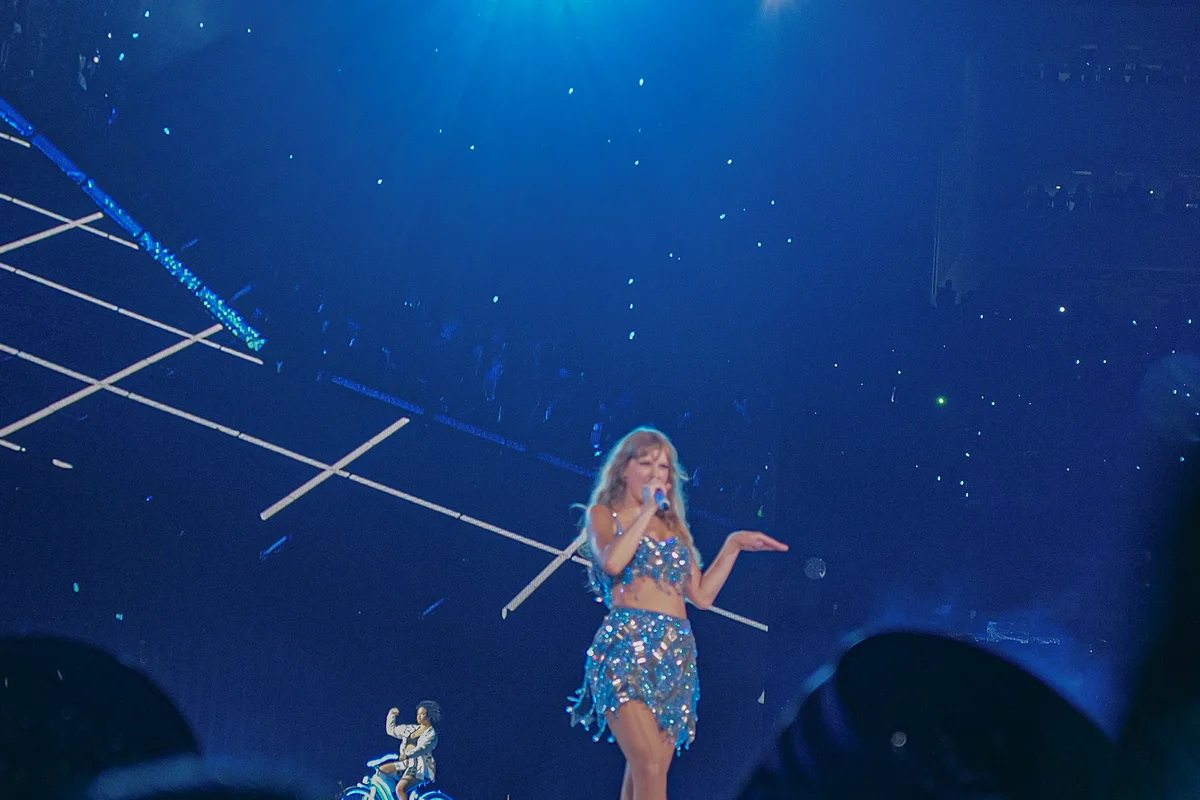
Hero photo: Taylor Swift performing the 1989 era set on The Eras Tour, photographed by Paolo V, CC BY 2.0 (via Wikimedia Commons). The photo is of a live performance and is not connected to the Vanity Fair profile. Source: https://commons.wikimedia.org/wiki/File:Taylor_Swift_The_Eras_Tour_1989_Era_Set_(53109741404).jpg — no logos or watermarks. Updated 27 November 2026.
Share this article