Timur (Sichuan Pepper): The Tingling Spice of Uttarakhand
By My Quick Trippers · 12 Nov 2026
8 min read · Food & Cuisine
Timur is the Himalayan cousin of Sichuan pepper: the dried fruit of Zanthoxylum armatum, a thorny shrub of the temperate Himalaya. It is not black pepper and it is not a chilli. It belongs to the citrus family, and it tastes like it — floral and citrusy, with the numbing tingle that prickly-ash peppers are known for. This post is about that tingle: what timur is, how hill kitchens use it, and how it differs from the ordinary pepper on the shelf.
The first thing to understand about timur is that it is not a pepper in the way black pepper is a pepper, and it is not hot in the way a chilli is hot. Black pepper is the dried berry of a vine; a chilli is a fruit that burns. Timur is the dried husk of a prickly-ash fruit, and what it does on the tongue is different from both: a floral, citrusy aroma, and then a buzzing, numbing tingle that builds slowly and fades slowly. Once you have tasted it, you do not mistake it for anything else.
What timur is
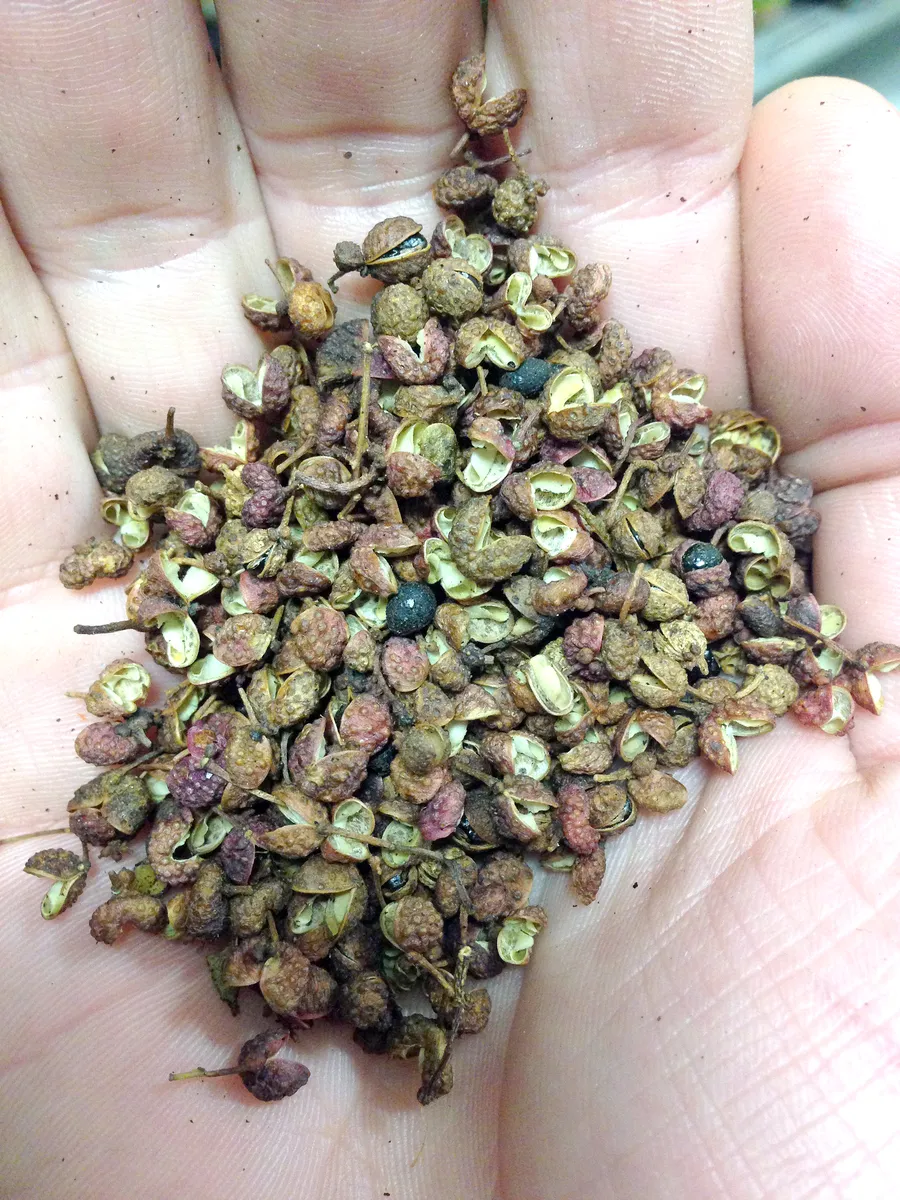
Timur is the dried husk of the fruit of Zanthoxylum armatum, a thorny shrub of the temperate Himalaya. The spice as sold is the dried husk — the split-open shell of the fruit — with the small black seed often still inside it. The photograph at the top of this post shows a handful of it: the split husks, olive-green to brown, with the black seeds among them. The aroma and the tingle sit in the husk, not in the seed, which is why the husk is the spice and the seed is not.
The plant grows across the Himalaya — in Uttarakhand, Nepal, Sikkim and beyond — in temperate valleys and on hillsides where the thorny shrub can grow undisturbed. In Nepal, timur is one of the most-used spices in everyday cooking, ground into curries, pickles and chutneys. In Uttarakhand, the state government launched Mission Timur in 2023 to promote its cultivation. The Sikkim Express piece that reports the mission presents Sikkim as a state that could replicate the model, growing the same thorny shrub in its own temperate valleys. The mission is about cultivation: promoting a spice that already grows in the temperate Himalaya, in the valleys where the shrub grows undisturbed. It is used across the Himalaya, including Uttarakhand, where it is a hill-market spice as much as a store spice.
Timur vs regular pepper
Timur is not black pepper. Black pepper is Piper nigrum, the dried berry of a tropical vine, and its heat is a sharp, warm pungency. Timur is Zanthoxylum armatum, a prickly ash of the citrus family, and its effect is a numbing tingle with a floral, citrusy aroma. They are different plants, different flavours, and different effects — and they are not interchangeable. A dish that calls for black pepper does not want timur, and a dish that calls for timur does not want black pepper.
Timur is not a chilli either. A chilli burns: its heat is capsaicin, and it sits at the back of the throat. Timur numbs: the tingle is a buzzing on the lips and tongue, and it comes with a citrusy, floral aroma that chillies do not have. The two are often used together — timur with chillies in a pickle or a chutney is a classic Himalayan combination — but they do different jobs, and the cook who confuses them will season the dish wrong.
The closest relative is Sichuan pepper itself. Timur is the Himalayan form of the same family of spices — the prickly-ash peppers that China calls hua jiao. The green Sichuan pepper of China and the timur of the Himalaya are cousins, not twins: the same tingling family, different valleys, slightly different flavour. If you know Sichuan pepper, you know what timur will do. If you do not, the first taste is a surprise worth having.
How hill kitchens use it
Timur is used ground, and very little of it. The store's description says it plainly: a little goes a long way. A pinch, ground, in a pickle or a chutney is enough — the numbing builds, and too much will take over the dish. It flavours curries, pickles, chutneys and stews, and it is the spice that makes a Himalayan pickle taste Himalayan rather than merely hot.
Use it ground, not whole, and add it late enough that its aroma survives the cooking. Whole husks in a pot give up their flavour slowly and unevenly; ground timur disperses through the dish, and a pinch is easy to measure. If you are cooking with it for the first time, start with less than you think you need, taste, and add more next time. There is no dish in which timur is the main ingredient; it is always the seasoning, and the seasoning that numbs is the seasoning to respect.
It sits in the same spice cluster as the other hill seasonings in the store: jakhya, the crackling tadka seed; jambu, the dried Himalayan chive; haldi, the everyday turmeric; and tej patta, the Indian bay leaf. Our guide to Himalayan spices introduces all of them, and our guide to jakhya covers the tadka seed in full. Timur is the tingling one of the group — the spice that does something no other spice in the cluster does.
A pinch at a time
The rule for timur is a pinch, ground. The store's description says it plainly — a little goes a long way — and the cooking follows from it: grind the dried husk, use a pinch in a pickle or a chutney, and taste before adding more, because the numbing builds and too much will take over the dish. Whole husks give up their flavour slowly and unevenly, so ground timur is the form to cook with: it disperses through the dish, and a pinch is easy to measure. Buy a small pack first — the store sells 60 g, and 60 g of timur lasts a household a long time at a pinch per dish — and there is no dish in which timur is the main ingredient. It is always the seasoning, and the seasoning that numbs is the seasoning to respect.
One honest note about the photograph
The photograph at the top of this post is a handful of Sichuan pepper — the dried husks, with the black seeds among them — by Max Ronnersjö (CC BY-SA 3.0, via Wikimedia Commons). It shows the dried husks as sold, the green variety dried to olive-green and brown. It is not fresh berries on the branch, and it is not the growing shrub: it is the spice itself, in the hand, in the form you buy it. The pack in the store is the same dried husk.
Where to buy timur
Timur is sold in our Pahadi Store at an indicative ₹199 for 60 g, from The Pahari Life, checked 12 Nov 2026. The price is indicative, not fixed: it comes from that seller's live listing, not from our own supplier list, so check the store page for the current figure before ordering. Buy a small pack first — 60 g of timur lasts a household a long time at a pinch per dish.
Frequently Asked Questions
What does timur taste like?
Floral and citrusy, with a numbing tingle on the tongue. It is a prickly-ash pepper (Zanthoxylum armatum), related to Sichuan pepper — not black pepper and not a chilli.
Is timur the same as black pepper?
No. Black pepper is Piper nigrum, the dried berry of a tropical vine, with a sharp, warm pungency. Timur is Zanthoxylum armatum, a prickly ash of the citrus family, with a numbing tingle and a floral, citrusy aroma. They are not interchangeable.
Is timur the same as Sichuan pepper?
Timur is the Himalayan cousin of Sichuan pepper — the same family of prickly-ash peppers, from a different valley. The green Sichuan pepper of China and the timur of the Himalaya are cousins, not twins: the same tingling family, slightly different flavour.
How much timur should I use?
Very little, ground. A pinch in a pickle or a chutney is enough — the numbing builds, and too much will take over the dish. Start with less than you think you need and add more next time.
Should I use timur whole or ground?
Ground. Whole husks give up their flavour slowly and unevenly; ground timur disperses through the dish and a pinch is easy to measure. Add it late enough that its aroma survives the cooking, start with less than you think you need, and taste before adding more — the numbing builds, and too much takes over the dish.
Where can I buy timur?
In the Pahadi Store, at an indicative ₹199 for 60 g (The Pahari Life, checked 12 Nov 2026). Buy a small pack first — 60 g lasts a household a long time at a pinch per dish.
Sources
- My Quick Trippers — Pahadi Store
- My Quick Trippers — Himalayan spices you've never heard of
- My Quick Trippers — Himalayan jakhya spice
- The Pahari Life — Timur product listing
- Sikkim Express — Mission Timur: Unlocking the Potential of Sichuan Pepper in Sikkim
- Wikimedia Commons — A handful of Sichuan pepper, Max Ronnersjö, CC BY-SA 3.0
Share this article