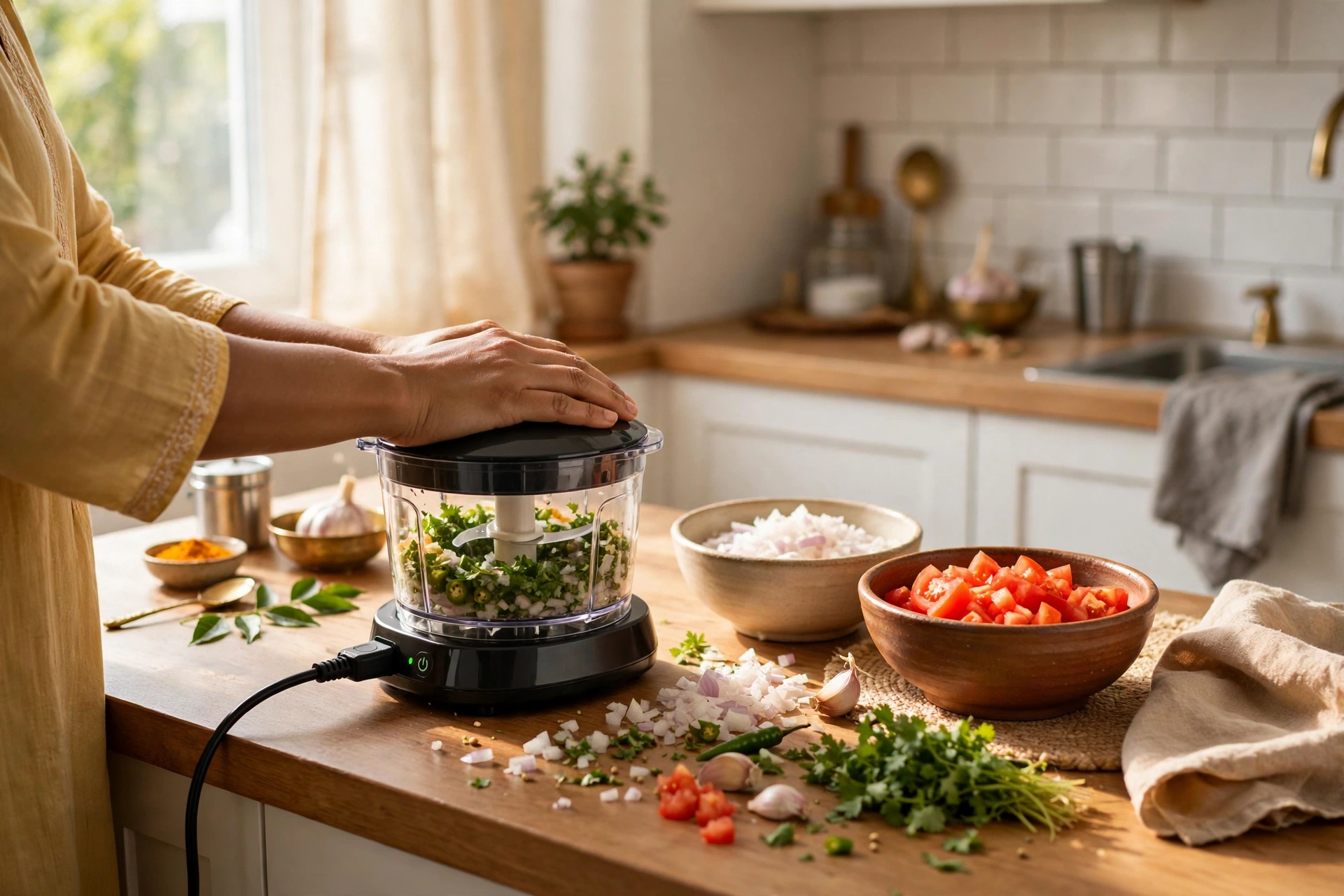
AGARO Delite Electric Chopper India Review: Viral Kitchen Hack or Just Hype?
By My Quick Trippers · 21 Oct 2026
7 min read · Travel Gear
Recommended gear
AGARO Delite Electric Chopper — Worth It?
AGARO Delite electric chopper (stainless bowl)
Picked for the daily tadka — small batches, steel bowl that does not stain; check wattage and bowl size on the listing before buying
As an Amazon Associate, we earn from qualifying purchases. We may earn a commission if you buy through these links, at no extra cost to you.
Every Indian kitchen has the same unpaid job: the daily onion-tomato-chilli chop for the tadka. It is boring, it makes your eyes water, and on a busy morning it is the reason breakfast gets delayed. The AGARO Delite electric chopper went viral because it attacks exactly that job — a pile of onions in, tadka-ready pieces out, in seconds. After digging into the reviews and the actual demo video, my verdict is simple: this is a genuinely useful gadget for small families who cook daily, and a waste of counter space if you only cook on weekends. It is not magic, and it will not replace your knife. But for the one repetitive job it does, it does it well.
Why choppers are suddenly everywhere
The mini electric chopper became a headline pick in India's 2026 kitchen-gadget guides, described as one of the most useful gadgets for everyday cooking. That is not an accident. Indian cooking is chop-heavy in a way most Western kitchens are not: onions, tomatoes, ginger, garlic and green chillies form the base of most meals, and they need chopping almost every single day. A tool that cuts that prep from ten minutes to under a minute lands differently here than it does in a kitchen that cooks twice a week. The AGARO Delite rides that wave — it is the model that keeps appearing in Indian demo videos, including the review embedded below, which has crossed 22,000 views in six months.
Pros
What it actually does well
The core job is chopping, and the Delite handles the daily trio — onion, tomato, chilli — fast. The demo shows the familiar rhythm: drop the pieces in, press down, and the blades turn a whole onion into usable pieces in a few pulses. For tadka, curry bases, chutneys and salads, that consistency is good enough, and the time saved is real. Anyone who has stood chopping three onions while the oil heats will feel the difference immediately. The stainless-steel bowl is the other genuine plus: steel does not stain the way plastic does after turmeric and tomatoes, it does not hold on to smells, and it feels like it will survive daily use rather than clouding up in a month. For a gadget that lives in the masala zone of your kitchen, that matters more than any feature list.
Size is the quiet advantage. This is a mini chopper, not a full food processor, which means it fits in a normal Indian kitchen without a dedicated shelf. It comes out for the tadka, does its job, and goes back. That is the difference between a gadget you use and a gadget that becomes decoration: the small ones get used because putting them away is not a project. If your kitchen is already crowded with a mixer-grinder and a pressure cooker, a compact chopper is the only kind of extra appliance that has a chance.
Cons
Where it falls short — the honest cons
First, capacity. A mini chopper means small batches. If you are cooking for six people and need a mountain of chopped onions, you will be running two or three rounds, and at that point the time saving starts to shrink. This is a two-to-four-person gadget, and buyers feeding a joint family should know that before ordering. Second, uniformity. An electric chopper does not dice like a careful hand with a knife — some pieces come out finer than others, and if you over-pulse by even a second you get paste instead of pieces. There is a learning curve of about a week before you instinctively know how many pulses your tadka needs. Third, cleaning. The blades are sharp, and the blade assembly needs careful washing by hand — this is not a throw-everything-in-the-sink gadget. And fourth, it is one more thing on the counter. If your kitchen storage is already full, be honest with yourself about whether it will live on the counter or in a loft.
One more caution that applies to every viral kitchen gadget: listings vary. Wattage, bowl size and included blades can differ between sellers and batches, so check the listing details on the product page before you buy rather than trusting any single review's spec sheet. The price band sits around ₹900, but sale prices move — treat that as an approximate band, not a promise.
Who should buy it — and who should skip it
Buy it if you cook most days, your household is small, and chopping is the part of cooking you dread. It earns its keep fastest for working couples, bachelors who actually cook, and anyone who makes tadka-based food five or six days a week. Skip it if you cook rarely, if you already own a food processor with a chopping attachment, or if you genuinely enjoy knife work — no gadget improves on a skill you already like. Also skip it if your family size means you would always be doing multiple batches; a bigger chopper or the old knife-and-board will serve you better. If you like the idea of small kitchen upgrades that actually get used, our portable blender bottle review covers another compact gadget in the same spirit, and the self-stirring mug review is the same idea applied to chai.
Getting the best chop: technique matters more than power
A chopper rewards good technique, and the technique is simple once you know it. Cut everything into roughly equal pieces before loading — a whole onion halved and quartered will chop far more evenly than a mix of big chunks and small bits. Do not overfill: half-full chops better than a packed bowl, because the blades need room to throw the pieces around. Pulse in short bursts of one or two seconds, and give the bowl a shake between pulses so the pieces on top fall back down to the blades. That shake-and-pulse rhythm is the difference between even pieces and a bowl that is paste at the bottom and chunks at the top. Chop hard things separately from soft ones — ginger and garlic first, on their own, then add onion and tomato — because one pulse count cannot suit both. And rinse the bowl and blades soon after use: turmeric and tomato stain less when they do not dry on, and the steel bowl stays looking new if you dry it rather than leaving it to drip-dry with water spots.
Watch reviews
The video below is an independent review by Spice & Soul Diaries — it is their video, not ours — and it shows the Delite chopping in a real kitchen, which tells you more than any spec list. Watch how many pulses it takes to get tadka-ready pieces, because that is the number you will live with every day.
Verdict: viral or hype?
Mostly viral, with honest limits. The AGARO Delite chopper earns its popularity because it solves a real, daily, boring problem in Indian kitchens — and it does it at a price band around ₹900 that does not need much justification. The hype part is the idea that it replaces all chopping: it does not, and it should not try. Buy it for the daily tadka, keep your knife for everything else, and you will be happy. I have chopped onions by hand for years, and the first time I watched this turn a whole onion into tadka-ready pieces in seconds, I understood exactly why it went viral — that is the moment that sells it, and it is real. For more small gadgets that punch above their price, see our foldable keychain tote review and the Stanley-style tumbler dupe review, both in the same honest-review series.
Share this article