Foldable Keychain Tote Bag India Review: Viral Travel Hack or Just Hype?
By My Quick Trippers · 20 Oct 2026
10 min read · Travel Gear
Recommended gear
Foldable Keychain Tote Bag — Worth It?
Foldable keychain tote bag (reusable)
Picked for the Jaipur bazaar souvenir run — same factory bag under many brand names, so buy the cheapest listing
As an Amazon Associate, we earn from qualifying purchases. We may earn a commission if you buy through these links, at no extra cost to you.
Honest verdict
buy it — a ₹300–₹500 foldable tote that earns its keychain space on souvenir and market days; skip it if you need a bag for heavy loads, the thin fabric is not built for that
Check Price on AmazonScroll Instagram for five minutes this week and you will meet it: a small pink polka-dot pouch on a keychain, no bigger than a matchbox. A hand pulls a tab, and the pouch unfolds — and keeps unfolding — into a full-size black tote bag. The creator, Deepanjal Goyal (@simboyexplorer), then proceeds to stuff it with sunscreen, face wash, shampoo, perfume, and half his bathroom shelf while the on-screen scorecard flashes his verdict across 128 tested products: 70 of them "Paisa Wasool". The reel, posted on October 17, pulled 17,000 likes and 1,500 comments, and the comments are almost entirely one repeated plea: "link please".
So the foldable keychain tote bag is officially having its viral moment in India. But here is the question no 15-second reel answers: is this a genuine travel hack, or just another novelty that ends up crumpled in a drawer after two uses? As someone who has watched countless "Amazon Finds" fads arrive with fanfare and die quietly, I wanted to look at this one through a traveller's eyes — because if there is one lifestyle where a bag that lives on your keyring might actually earn its keep, it is travel, where the souvenir shopping always exceeds the bag space you packed.
What exactly is a foldable keychain tote bag?
Strip away the viral editing and the product is disarmingly simple. It is a reusable shopping tote, usually around 38 to 40 cm wide when open, made from thin nylon or polyester, that folds down into a pouch roughly 8 by 6 cm — about the size of a credit-card holder. The pouch has a keyring or small carabiner, so it clips onto your keys, your handbag strap, your backpack loop, or your belt. When you need a bag, you unclip the pouch, pull the tote out, shake it open, and you have a full-size carry bag. When you are done, you fold it back into its own pouch — the pouch is attached to the bag itself, so it cannot get lost separately.
On Amazon.in, these sell mostly from small, no-name brands, usually priced between ₹300 and ₹500 for a single bag, with multi-packs bringing the per-bag cost down. Colours range from basic black to loud prints. There is no meaningful brand hierarchy here — two listings with different brand names are very often the same factory product in different packaging, so paying a premium for a "brand" buys you nothing but a nicer pouch print. The specs that matter are the open dimensions (check the listing, because some run disappointingly small), the fabric weight, and the handle stitching.
Why is it going viral right now?
The virality is, as usual, mostly about the format. The keychain-to-tote transformation is perfect short-video content: the before-and-after lands in three seconds, the reveal feels faintly magical, and every viewer instantly pictures the same relatable moment — standing at a shop counter with more stuff than hands. Indian "Amazon Finds" and "Meesho finds" compilations picked it up because it sits in the impulse sweet spot: cheap enough to buy without thinking, novel enough to film, and practical enough that nobody feels silly for wanting one. The timing helps too — we are in the middle of the festive shopping season, when everyone is buying more than they planned to carry.
There is also a specifically Indian frustration doing quiet work underneath the trend. Carry-bag charges — ₹10, ₹15, ₹20 at billing counters — have trained a whole generation to feel a small sting every time they forget a bag. And travellers know the bigger version of that sting: the last day of a trip, when the suitcase is full, the souvenirs are many, and you are redistributing weight across shopping bags at the hotel reception. A backup bag that weighs 76 grams and lives on your keyring is aimed precisely at that moment. It is not an accident that the viral demo shows the bag swallowing toiletries and personal-care bottles — the pitch is "the bag you always have with you," and for once the pitch matches a real recurring annoyance.
The honest pros
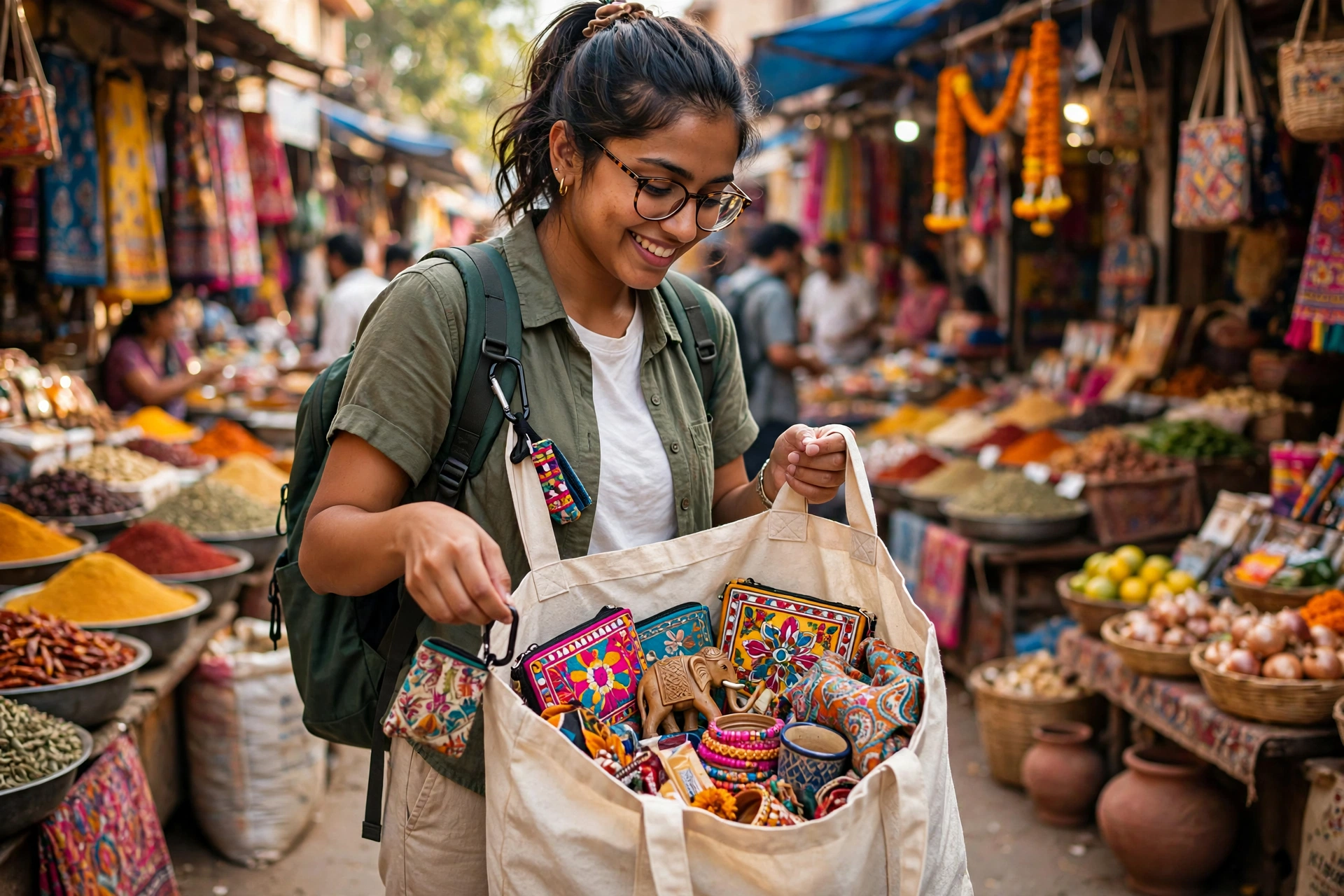
Let us give credit where it is due, because unlike a lot of viral gadgets, this one solves a problem that actually recurs. The strongest case is the souvenir and market run. Anyone who has wandered through Jaipur's Johari Bazaar, a Goan flea market, or Delhi's Sarojini Nagar knows the pattern: you planned to "just look", and now you own four kurtis, a marble elephant, and spices for the whole family. A tote that was clipped to your daypack all along turns that from a juggling act into a non-event. Airport duty-free overflow is the same story — the extra shopping bag you did not plan for, handled without buying another flimsy plastic sack.
The second case is the packability math, which is genuinely excellent. A standard reusable tote weighs 150 to 200 grams and occupies real space in a daypack; you have to remember to pack it, which is the entire failure mode of reusable bags. This one weighs about as much as your phone charger and lives on a clip you already carry — there is nothing to remember. Fold it into your packing system once, and it is simply there on the one random Tuesday in Udaipur when you need it. For beach days, it doubles as a sand-proof-ish day bag for the shack run; on cold mornings, it swallows the extra layer you shed by 10 AM.
The best travel gear is the gear whose absence you would actually feel — and nothing ruins a market stroll like juggling six paper bags with no free hand for the chai.
Cons
The honest cons
- ✕ Thin single-layer fabric — great for clothes and souvenirs, not for heavy groceries
- ✕ Handles are stitched, not reinforced — the first thing to fail on cheap units
- ✕ No zip or closure — keep your wallet and phone in your main bag
- ✕ The tiny pouch is easy to leave behind if you unclip it at a counter
- ✕ Hand-wash only; machine washing ruins the fold-back-into-pouch trick
Now the other side, because a ₹400 bag has compromises and you should know them before the buy button. Durability is the big one. The fabric is thin by design — that is the whole point — which means it handles clothes, souvenirs, snacks, and toiletries fine, but it is not a grocery workhorse. Do not load it with 5 kg of atta or a watermelon and act surprised. The handles, not the fabric, are the usual failure point: they are stitched rather than reinforced, and the stitching is where cheap units give up first. Treat it as a light-to-medium-duty bag and it will last; treat it like a jute sack and it will not.
The second con is subtler: the product solves "I forgot my bag" but introduces "I unclipped the pouch at the shop counter and left it there." The pouch is small and easy to misplace the moment it is separated from your keys. Discipline helps — unclip, unfold, and immediately clip the empty pouch back onto something. There are also the small print realities: most versions have no zip or closure, so valuables stay in your main bag; the thin fabric is water-resistant, not waterproof, so it will shrug off drizzle but not a downpour; and it is hand-wash only, because machine washing destroys the crisp folds that let it pack back down into its pouch.
Travel use cases: where it actually shines
Map it to specific travel scenarios and the buy-or-skip decision gets clear. Market and bazaar days are the clear winner — Jaipur, Jodhpur, Varanasi, Kochi's spice markets, anywhere the shopping finds you rather than the other way around. Airport and station runs come second: the duty-free extras, the snacks for the train, the last-minute bookstore haul. Beach and shack days are third: it is a fine sand-adjacent day bag for the towel-sunscreen-book run, and it shakes clean. Road trips get an honourable mention — it is the bag that lives in the glovebox for the dhaba pickle jars and farm-produce stalls you absolutely will stop at.
Where it does not belong: as your primary daypack (no padding, no structure, no security), on treks (the weight saving is real but the durability is not — stick to the proven kit in our kedarnath packing guide), or for anything you would cry over losing, since there is no zip. It is a backup bag, and backup bags should be judged on one metric: is it there when the unplanned moment arrives? Clipped to your daypack, this one passes that test better than any tote you have to remember to pack.
Who should buy it, and who should skip it
Buy it if: you travel with a daypack or handbag it can clip to; your trips involve markets, bazaars, or flea markets (so, most India trips); you are tired of paying carry-bag charges on principle; or you just like the idea of a 76-gram insurance policy against the "I need a bag" moment. At ₹300 to ₹500 it is comfortable impulse-buy territory, and even if you use it five times a year, the cost-per-use math is absurdly favourable. Travellers doing the budget circuit will appreciate that this is one of the cheapest genuine upgrades you can make to your kit.
Skip it if: you already own a packable tote you actually remember to carry (no need for two); you are a strict minimalist who resents single-purpose items — though at keychain size, this barely counts as an item; you need something heavy-duty for real loads; or you know yourself well enough to admit the pouch will live in a drawer, unclipped, from week two. There is no shame in that last one. Our hostel travel guide covers the dorm-room essentials that matter far more than any single gadget, and an honest packing list beats a viral one every time.
Decided? Check the live price before you order.
Check Price on AmazonAs an Amazon Associate, we earn from qualifying purchases. Prices change often — check the live price on Amazon before ordering.
What to check before you buy
If you decide to get one, a few practical checks will save you from the most common disappointments. First, verify the open dimensions in the listing — "large capacity" means nothing; look for actual numbers around 38 to 40 cm wide, and be suspicious of listings that only show the folded size. Second, zoom into the customer review photos and look at the handle stitching; neat, dense stitching is the difference between a bag that lasts a year and one that lasts a month. Third, read the recent reviews, not the rating average — look specifically for "tore at the seam" or "handle broke", which are the two failure modes, and check whether they cluster in the last few weeks (a sign the seller changed suppliers).
Fourth, prefer a carabiner-style clip over a plain split ring if you have the choice — it is faster to move between bags and less likely to work itself open. And finally, do not pay a premium for brand names you cannot verify; in this segment, two listings with different brand names are often the identical product. The honest verdict: this is one of the rare viral products where the use case survives contact with reality. It will not change your life, but on the one market day per trip when you need a bag you did not pack, you will be very glad it was hanging off your keyring. For the rest of your kit, our char dham packing list covers what actually deserves space in the bag.
Share this article