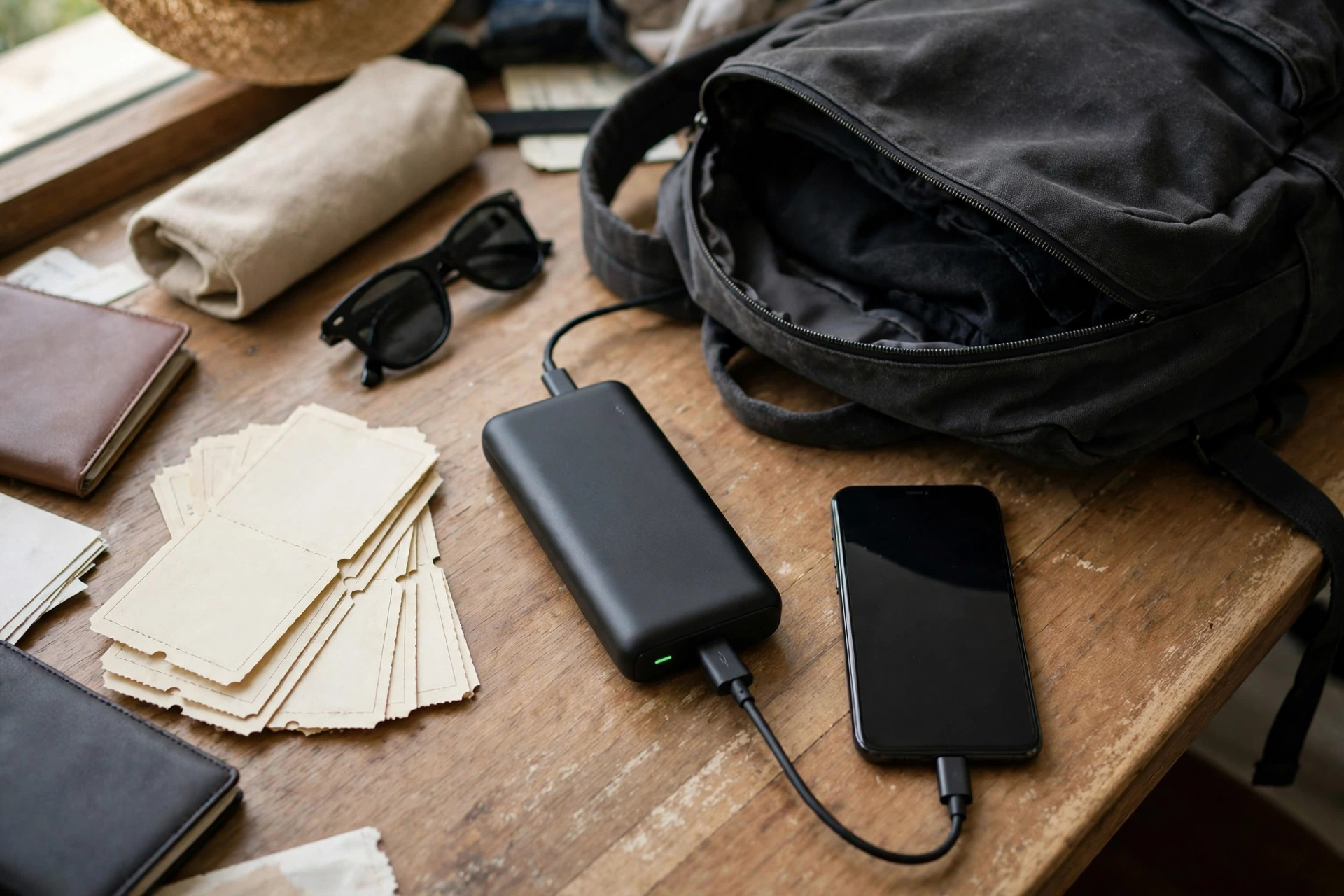
Ambrane 10000mAh Power Bank India Review: The Gift-Guide Regular?
By My Quick Trippers · 21 Oct 2026
7 min read · Travel Gear
Recommended gear
Ambrane 10000mAh Power Bank — Worth It?
Ambrane 10000mAh power bank
Two phone charges from a known brand; confirm 10000mAh capacity, not 20000mAh
As an Amazon Associate, we earn from qualifying purchases. We may earn a commission if you buy through these links, at no extra cost to you.
Honest verdict
for everyday carry, commuting and gifting, this is a sensible, safe buy.
Check Price on AmazonA power bank is the most boring essential you own — until your phone dies at 4 percent on a train, in a market, or halfway through a day out. Then it is the most important thing in your bag. The Ambrane 10000mAh power bank is a gift-guide regular from an established Indian brand, priced at around ₹899 against a listed MRP of ₹1,499. Ten thousand milliamp-hours is the sweet spot most buyers actually need: enough for roughly two full phone charges, small enough to carry daily. My verdict: for everyday carry, commuting and gifting, this is a sensible, safe buy. For laptops or multi-day trips, you need a bigger class entirely.
What a 10000mAh power bank actually is
The capacity number is the whole story. A 10000mAh bank holds roughly enough charge for two full charges of most modern phones, after conversion losses — one charge for you, one for a friend, or a top-up across two days. Ambrane is an established Indian accessories brand, which matters for a product that is essentially a battery you carry in your pocket: known brands mean tested cells, proper safety circuits and a warranty you can actually use. The model name needs care, as always: Ambrane sells many capacities and variants, and this review is specifically about the 10000mAh model. Confirm the capacity in the listing before ordering, because a 20000mAh bank at a similar headline price is a different product, not a better deal on the same one.
Pros
What it does well
The first win is the capacity-to-size balance. Ten thousand milliamp-hours covers a full day out, a long commute, or a weekend trip with one overnight recharge, without the brick-like weight of a 20000mAh bank. The second win is the price: at around ₹899 against a ₹1,499 MRP, it sits in impulse territory for something you will use for years, and it is cheap enough to keep one in the bag and one at home. The third win is the brand factor — an established Indian brand with a gift-guide presence means the cells, circuits and warranty are a known quantity rather than a gamble, which matters more for batteries than for almost any other gadget. The fourth win is gifting: a power bank is the rare gift that is universally useful, and a known-brand 10000mAh bank at this price is the safe choice for birthdays, festivals and travel send-offs. If you like travel-ready gadgets that actually get carried, our portable blender bottle review covers another compact companion in the same spirit.
Cons
Where it falls short — the honest cons
First, capacity has limits. Ten thousand milliamp-hours will not charge a laptop, will not cover a three-day trip without recharging the bank itself, and will not serve a family of four phones — buyers with those needs should look at the 20000mAh class instead. Second, charging speed depends on the combination of bank, cable and phone: check the listed output against your phone's fast-charging needs rather than assuming every bank fast-charges every phone. Third, check what is in the box before ordering — cables vary by listing, and needing a separate cable is an annoying surprise. Fourth, weight and pocket feel are personal: a 10000mAh bank is portable, but it is still a noticeable rectangle in a jeans pocket, and ultra-light buyers may prefer a smaller bank or a MagSafe-style one. Finally, battery products age: after a year or two of daily use, capacity drops, which is normal for lithium cells and not a defect — but it means a bank bought today is a two-to-three-year product, not a lifetime one.
Who should buy it — and who should skip it
Buy it if you commute, travel, or spend long days away from a plug; if you want a reliable daily-carry bank; or if you need a safe, useful gift. It is also a good second bank — one for the bag, one for the house. Skip it if you need to charge a laptop, if you go days without power access, or if you regularly charge multiple devices — the 20000mAh class serves those needs better. Skip it too if you want the lightest possible pocket carry and mostly top up a single phone; a smaller bank may suit you more. And skip any listing that cannot clearly confirm the 10000mAh capacity; a different capacity is a different product.
Buying checklist before you order
Confirm the 10000mAh capacity — not 20000mAh or another variant — in the listing title and model details. Check the listed output against your phone's charging needs, and confirm what cable, if any, is included. Check the seller rating and return policy, and read reviews for swelling, port-loosening or capacity complaints, which are the real long-term signals for battery products. Treat the price band of around ₹899 as approximate, with the ₹1,499 figure as the listed MRP rather than a price you should expect to pay. Charge the bank fully before first use, and store it half-charged if you will not use it for weeks — lithium cells age slowest around half charge. Used with those habits, a 10000mAh bank is one of the least glamorous and most useful purchases you will make.
Power bank habits that actually matter
A power bank fails in exactly two ways that buyers can prevent: a bad cable and a dead bank. The cable matters more than people think — a frayed or ultra-cheap cable charges slowly, heats up, and makes a good bank look faulty, while a decent cable lets the bank deliver what it is rated for. If your phone charges slowly from the bank but quickly from the wall, suspect the cable before the bank. The dead-bank problem is simpler: a bank left empty for months loses capacity, and a bank left plugged in for days sits at full charge under stress. The practical routine is to recharge the bank after a heavy-use day, keep it roughly half-charged if you will not use it for weeks, and give it a full cycle occasionally. These habits sound fussy, but they are the difference between a bank that lasts two years and one that fades in six months.
The one-bank-or-two question is worth answering honestly. Most buyers need one bank in the bag and, if they travel or work long days, benefit from a second kept charged at home or in the office — not because one bank is insufficient, but because the failure mode of a single bank is a dead phone at the worst moment. At around ₹899, a second Ambrane bank is cheap insurance, and it doubles as the gift you give when someone else's phone dies. For families, the arithmetic is similar: one bank per two people is the practical ratio for outings, since sharing a single bank means someone is always waiting. None of this requires buying the biggest bank available — it requires buying the right size twice, and 10000mAh is the size most people actually carry, which is why it is the sweet spot this review recommends.
The bottom line
The Ambrane 10000mAh power bank earns its gift-guide-regular status by being exactly what most people need and nothing they do not: two phone charges, a known brand, a fair price, and a size you will actually carry. It will not run a laptop, survive a week off-grid, or impress anyone — and it was never designed to. Buy the exact 10000mAh model from a reviewed seller, test it on your real phone and cable in the return window, and judge it after a month of daily carry. If it lives in your bag and you stop thinking about battery percentage, it has done its job. For everyday carry, commuting and gifting, this is the safe, sensible pick — and safe and sensible is exactly what you want from a battery.
Share this article