Kala Bhatt Flour: Roti, Cheela and Everyday Uses
By My Quick Trippers · 13 Nov 2026
9 min read · Food & Cuisine
Most hill kitchens cook kala bhatt whole — soaked overnight, simmered into churkani, ground into dubke. But there is a quieter, everyday form of the same bean that never gets a recipe post of its own: the flour. Grind the dry bean and you get a dark, nutty flour that goes into roti, into cheela, and into the everyday doughs of a hill kitchen. Our post on kala bhatt, the black soybean explains the bean itself, and our bhatt ki churkani post covers its most famous whole-bean dish. This post is about the flour: how the bean becomes flour, what the flour does in a roti, how it makes a cheela, and where it fits in an ordinary week of cooking.
One promise first, the same one this series makes for every pulse. There are no health claims here: this post does not say kala bhatt cures or prevents anything, and there are no nutrition numbers, because none have been verified for this flour. What follows is about the bean, the grinding stone and the griddle — the things a hill kitchen actually does with a kilo of black soybean when it is milled rather than simmered.
From bean to flour
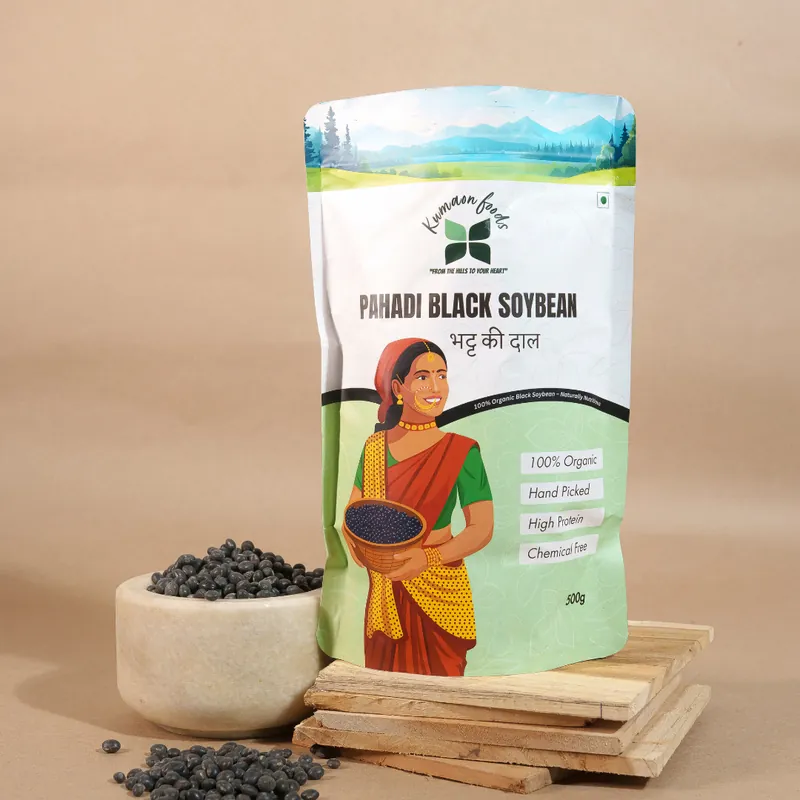
Kala bhatt is black soybean, Glycine max — the black-seeded form of the soybean, grown in the Uttarakhand hills. The beans are small, round and black, with a pale hilum, the small scar where the bean attached to the pod. To make flour, the dry beans are cleaned, picked over for stones and broken seeds, and ground — traditionally on a stone chakki or a hand mill, today often at a neighbourhood flour mill. The result is a fine, dark, speckled flour that smells faintly nutty even before it meets water. It is not a flour that keeps forever: like any freshly ground pulse flour, it is best used within a few weeks, kept in a dry, airtight jar away from damp, because the hills are humid and a ground pulse picks up moisture faster than whole beans do.
Grinding at home or at the mill is a choice, and both are common. A household that grows its own bhatt may grind a small batch at home on a hand chakki, a kilo at a time, and use it within the week. A household that buys the bean from the store usually takes it to a flour mill with the rest of the household grain, and asks for a fine grind — fine enough that the flour passes through the fingers without grit, because a coarse grind makes a rough roti and a cheela that never sets smoothly. Either way, the flour is made from the whole dry bean, ground as it is, and it is used the way the hills use every pulse flour: as an addition to the dough, not as the dough itself.
Bhatt flour roti
The roti is the simplest use of the flour, and the one most hill households reach for first. Mix the bhatt flour with wheat flour, add salt and a little water, and knead it into a soft dough — softer than a plain wheat dough, because the pulse flour drinks more water. Rest the dough for fifteen or twenty minutes, then roll the rotis a little thicker than usual and cook them on a hot griddle, pressing gently with a cloth so they puff. A spoonful of ghee on top, and the roti is ready. The taste is the point: the roti is darker than a wheat roti, nutty and earthy, with a faint bitterness at the edges that wheat alone never gives. It is eaten the way any roti is eaten — with dal, with sabzi, with a spoonful of chutney — but it carries more of the meal on its own than a plain roti does.
Bhatt flour cheela
The cheela is where bhatt flour earns its keep as a cook's ingredient rather than just a bread flour. A cheela is a thin savoury pancake, made from a batter rather than a dough: bhatt flour whisked with water into a smooth, pourable batter, with salt, finely chopped onion, green chilli, ginger and coriander, and sometimes a spoonful of rice flour to make the edges crisp. The batter rests for ten minutes, then a ladleful is poured onto a hot, lightly oiled griddle, spread thin with the back of the ladle, and cooked until the underside is golden and the top is set. It is flipped once, cooked briefly on the other side, and served hot, folded, with chutney or with a spoonful of curd.
The cheela is a different kind of cooking from the roti, and the difference is in the batter. A roti dough is kneaded and rested; a cheela batter is whisked and poured. The flour behaves differently in each: in the dough it gives flavour and weight, in the batter it gives body and a crisp edge. A good cheela batter is thin enough to spread and thick enough to hold its shape — about the consistency of a dosa batter, and the test is the ladle: if the batter runs off the ladle in a thin stream, it is right; if it falls in lumps, it needs more water; if it runs like water, it needs more flour. The first cheela is always the test — too thick, too thin, too hot a griddle — and the second one is the one that comes out right.
The cheela is the quick meal of the flour, and hill households treat it that way. It is breakfast food, tiffin food, the thing cooked when there is flour in the jar and no time for a full dal. A cheela takes minutes where churkani takes hours, and that is the point: the flour turns a slow bean into a fast meal. It is also the form that travels best — a cheela wrapped in a cloth stays good for hours, which is why it goes into tiffins for school and for the fields. The roti is the daily bread; the cheela is the fast bread, the one cooked when the day is already moving.
Everyday uses beyond roti and cheela
Beyond roti and cheela, the flour has a scatter of everyday uses that do not need a recipe of their own. A spoonful whisked into a dal thickens it, the way besan thickens a kadhi — stirred in at the end, cooked for a few minutes, it gives the dal body without changing its character. A spoonful mixed into a sabzi batter coats the vegetables for frying, the way a chickpea-flour coating does, and gives a pakora a darker, nuttier crust. And the flour goes into the dough for theplas and pooris on festival days, when the bread itself is meant to carry the flavour of the meal. None of these is a dish in its own right; all of them are the same move — a spoonful of bhatt flour where the cooking needs body, flavour, or both.
What the flour is not
Two confusions are worth clearing up, because the flour invites both. First, bhatt flour is not urad flour and not besan. Urad is black gram, a different plant, and its flour makes a different bread — softer, stickier, the flour behind idli and dosa batter. Besan is chickpea flour, the everyday frying flour of the plains. Bhatt flour is darker, nuttier and heavier than either, and it is not a substitute for them: a cheela made with besan is a besan cheela, and a cheela made with bhatt flour is a different thing, with a different taste. Second, the flour is not a shortcut to churkani. Churkani is a slow, whole-bean dish, and no amount of flour in a pot will make it — the flour is for bread, and the bean is for the pot, and the two forms are not interchangeable.
The flour also has its limits, and a cook should know them. It does not rise, so it will never make a leavened bread on its own. It does not bind the way wheat does, so a dough with too much of it will crack on the griddle. And it is strong-flavoured, so a little goes a long way — the one-to-three or one-to-four mix with wheat is not a timid suggestion, it is the ratio that keeps the bread a bread rather than a bean cake. Used within those limits, the flour is one of the most useful things in a hill kitchen; used beyond them, it is a lesson in why the limits exist.
Buying kala bhatt
Kala bhatt is in the Pahadi Store at a fixed ₹140 for 1 kg (MRP ₹180), sold by My Quick Trippers, checked 13 Nov 2026. The price is fixed, not indicative: it comes from our own supplier list, so the figure on the store page is the price. The store sells the whole bean, which is what you want for flour — buy it whole, pick it over, and grind what you need, a kilo at a time, rather than buying ready-ground flour that may have sat in a packet for months. One kilo of whole bean grinds into roughly a kilo of flour, and at a spoonful or two per roti batch, that kilo lasts a household several weeks of bread and cheela.
Frequently Asked Questions
Can I make roti with only bhatt flour?
Not easily. Bhatt flour has no gluten, so a dough made only of it cracks and crumbles on the griddle. Mix it with wheat flour — about one part bhatt flour to three or four parts wheat — and the wheat gives the dough the structure it needs while the bhatt flour gives the flavour. The same goes for mandua flour as the partner instead of wheat.
Is bhatt flour the same as urad flour?
No. Bhatt is black soybean and urad is black gram — different plants, different flours, different breads. Urad flour is the soft, sticky flour behind idli and dosa batter; bhatt flour is darker, nuttier and heavier, and it makes roti and cheela, not batter breads. Do not swap one for the other.
How do I make a cheela with bhatt flour?
Whisk bhatt flour with water into a smooth, pourable batter, with salt, chopped onion, green chilli, ginger and coriander. Rest it ten minutes, then pour a ladleful onto a hot, lightly oiled griddle, spread it thin, and cook until golden underneath. Flip once, cook briefly, and serve hot with chutney or curd.
How long does bhatt flour keep?
A few weeks in a dry, airtight jar, away from damp. Freshly ground pulse flour picks up moisture faster than whole beans do, so grind a kilo at a time and use it within the month. Whole bhatt keeps much longer than the flour, which is another reason to buy the bean whole and grind as you need it.
Sources
- My Quick Trippers — Pahadi Store
- My Quick Trippers — Kala bhatt: black soybean of Uttarakhand
- My Quick Trippers — Bhatt ki churkani: black soybean, slow-cooked
- My Quick Trippers — Types of pulses in India
Share this article