Kuttu Vrat Recipes: Buckwheat Dishes for Navratri Fasts
By My Quick Trippers · 12 Nov 2026
8 min read · Food & Cuisine
Kuttu is the flour that hill kitchens turn to when the fasts come around. It is buckwheat, Fagopyrum esculentum — a gluten-free pseudo-cereal, a seed used like a cereal but from a plant that is not a grass, suited to the cool high-altitude conditions of the hills. It is the classic fasting flour of Uttarakhand: the flour for kuttu ki roti, halwa, ladoo and cheela, chiefly eaten at Navratri. This post is about how it is cooked — the vrat dishes themselves, and the fasting rules that shape them.
The dishes below all start from the same bag of stone-ground flour, and they cover a fasting day end to end: roti for the meal, cheela for a quick breakfast, halwa and ladoo for the sweet, pakora for the evening snack. None of them needs wheat, rice or table salt, and none of them is complicated — the skill in kuttu cooking is not in long ingredient lists but in handling a flour that has no gluten and behaves differently from wheat at every step.
Kuttu ki roti: the fasting bread
Kuttu roti is the bread of the fasting season, and it is made differently from wheat roti because kuttu flour has no gluten to hold a dough together. Knead the flour with warm water, a little at a time, into a soft dough — it will feel crumblier and less stretchy than wheat dough, and that is normal. Roll the rotis small and thick, between the palms or between two sheets, because a thin kuttu roti tears. Cook on a hot tawa with a little ghee until both sides are cooked through, and eat hot with curd or a fasting sabzi, usually potato.
Two things go wrong with kuttu roti, and both have the same fix. If the dough cracks while rolling, it is too dry — wet your hands and knead in a few drops of water. If the roti breaks when you lift it, it is too thin — roll the next one thicker and smaller. Cook on a medium flame rather than a fierce one, so the thick roti cooks through to the middle without burning on the outside. A kuttu roti is never as thin or as puffed as a wheat roti, and it is not trying to be — it is a thick, soft, nutty bread, and that is the point of it.
Kuttu cheela: the quick pancake
Cheela is the quicker of the fasting breads — no kneading, no rolling, just batter and a hot pan. Mix kuttu flour with water into a pouring batter, with chopped green chilli and sendha namak, the rock salt used in fasts. Ladle it onto a hot greased tawa, spread it thin, and cook until the edges crisp and the top sets, then flip once and cook the other side. It is eaten hot, the same way as the roti, with curd.
Grated potato stirred into the batter makes a heartier cheela, and it is the commonest variation in hill kitchens — the potato adds body to a flour that has none of its own, and it cooks through in the same time as the batter. Keep the batter on the thin side rather than the thick side: a thick cheela stays raw in the middle while the outside burns, while a thin one cooks through and crisps at the edges. Cheela is the fasting breakfast for mornings when there is no time to knead and roll.
Kuttu halwa: the fasting sweet
Kuttu halwa is the sweet that most fasting households make first. Roast the flour in ghee on a low flame, stirring all the time, until it turns a shade darker and smells nutty — that roasting is the whole of the flavour, so do not rush it and do not let it burn. Add hot water a little at a time, stirring so no lumps form, then sugar or jaggery, and cook until the halwa thickens and starts to leave the sides of the pan. Serve warm, with a few chopped nuts on top if you have them.
Kuttu ladoo: the sweet that keeps
Kuttu ladoo is the same roasted flour, bound and rolled instead of cooked soft. Roast the flour in ghee as for halwa, stir in jaggery while the mixture is still warm, and roll it into round ladoos by hand before it cools and sets. The ladoos keep for days in a closed jar, which is why they are made in a batch at the start of the fasting season rather than one at a time. They are the fasting sweet that travels — carried to work, to school, on a journey — and they are eaten a little at a time, not all at once.
Kuttu pakora: the evening snack
Pakora is the evening dish of the fast, and kuttu batter is what makes it possible without wheat flour. Slice potato thin, dip the slices in a thick kuttu batter seasoned with green chilli and sendha namak, and fry until crisp. The batter should coat the slice and stay on it — if it slides off, the batter is too thin, so stir in a spoon more flour. Eat the pakoras hot, with curd or a green chutney made without onion or garlic, and make only as many as will be eaten at once: kuttu pakora goes soft as it cools, and it is a dish that is best straight from the pan.
The fasting rules that shape these dishes
The vrat dishes work the way they do because of what fasting sets aside. During Navratri, which runs for nine days, the true cereals — wheat and rice — are set aside, and the pseudo-cereals take their place: kuttu, chaulai and singhara are the three that turn up on fasting plates. Table salt is set aside too, and sendha namak, rock salt, is used instead. Potato, curd and fruit are allowed, and in many households onion and garlic are set aside along with the grains. Every dish in this post follows those rules — that is why there is no wheat flour in the batter, no table salt in the cheela, and no onion in the chutney.
Our guide to chaulai, the other fasting grain covers the same season from the other flour — popped seed for ladoo, boiled seed for kheer, ground seed for roti. Hill kitchens keep the two flours side by side during the fasting season, because a fast that runs nine days needs more than one flour: kuttu for the roti and the halwa, chaulai for the ladoo and the kheer, and the two together so no meal repeats itself.
Buying and storing kuttu flour
Buy stone-ground flour, and buy it fresh — flour goes stale faster than whole grain, and stale kuttu flour makes a bitter roti and a flat halwa. Check it before you cook with it: it should smell nutty and fresh, not musty, and it should be evenly ground, not gritty. Store it the way the hills store all their flour: in a dry, airtight jar, away from sunlight and damp, with the lid kept on. Buy in small quantities and use it quickly during the fasting season rather than stocking a large bag that sits open for months.
One honest note about the photograph
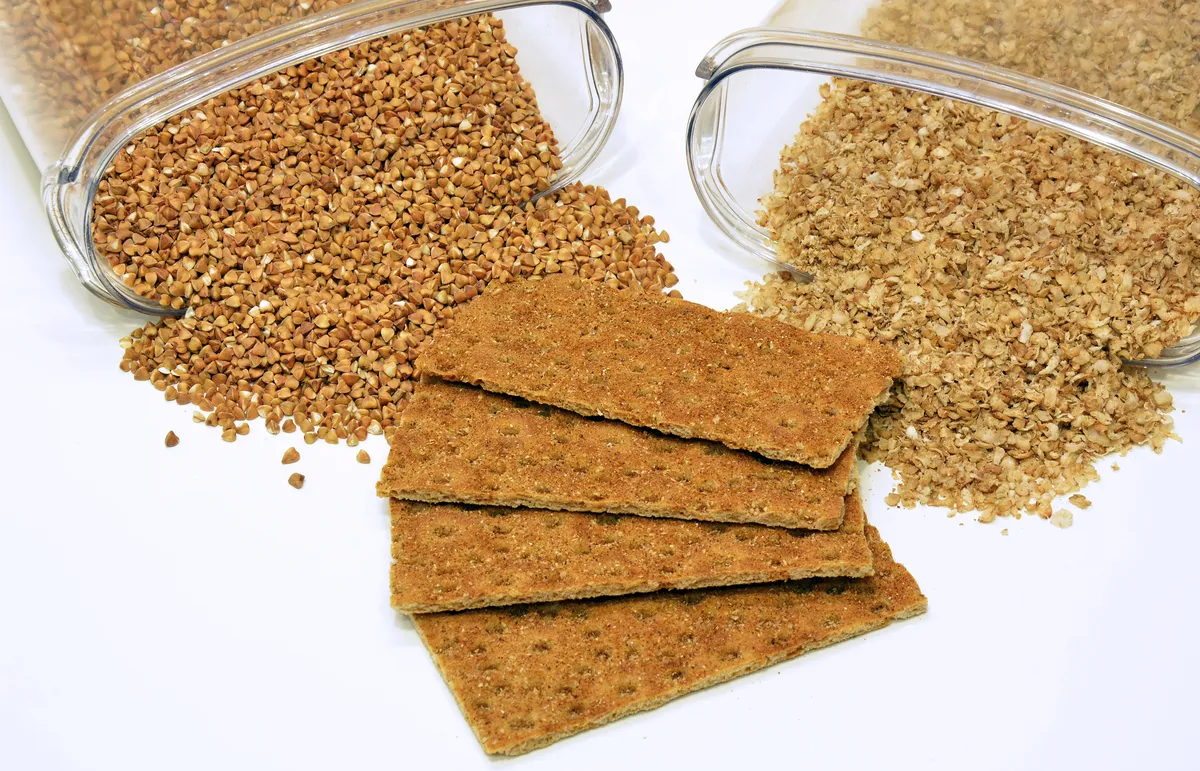
The photograph at the top of this post is buckwheat groats and crispbreads, by Andrey Korzun (CC BY-SA 4.0, via Wikimedia Commons). It shows the whole groats and a crispbread made from them — the pack sold in the store is stone-ground flour, not the groats pictured, so the photograph shows the grain kuttu comes from, not the flour itself.
Where to buy kuttu
Kuttu (Buckwheat Flour) is sold in our Pahadi Store at an indicative ₹250 for 1 kg, from Gauraaj via Aarogyamastu, checked 12 Nov 2026. The price is indicative, not fixed: it comes from that seller's live listing, not from our own supplier list, so check the store page for the current figure before ordering. Buy the stone-ground flour, keep it dry and airtight, and use it through the fasting season — roti, cheela, halwa, ladoo and pakora all start from the same bag.
Frequently Asked Questions
Is kuttu allowed during Navratri fasts?
Yes — kuttu is a fasting flour. Fasting rules set aside the true cereals, wheat and rice, and allow the pseudo-cereals, and kuttu is one of the three that turn up on fasting plates, alongside chaulai and singhara. Roti, cheela, halwa, ladoo and pakora are the fasting dishes made from it.
Why does kuttu dough crack when I roll it?
Because kuttu flour has no gluten, so the dough cannot stretch the way wheat dough does. Knead with warm water into a soft dough, roll the rotis small and thick, and wet your hands if the edges crack. A thick kuttu roti that holds together is right; a thin one that tears is not a failure of skill, it is the flour behaving as it does.
Can I make kuttu cheela without potato?
Yes — the plain cheela is just flour, water, green chilli and sendha namak, ladled onto a hot greased tawa and cooked until the edges crisp. Potato stirred into the batter makes a heartier cheela, but it is a variation, not a requirement.
How is kuttu halwa different from wheat halwa?
The method is the same — roast the flour in ghee, add water and sugar, cook until thick — but the flour is different. Kuttu flour is nutty and gluten-free, so the halwa is softer and darker than wheat halwa, and it thickens faster. Roast on a low flame and stir all the time, because kuttu flour burns more easily than wheat flour.
How do I store kuttu flour?
In a dry, airtight jar away from sunlight and damp, with the lid kept on. Flour goes stale faster than whole grain, so buy in small quantities and use it quickly — check that it smells nutty and fresh before you cook with it, and do not use flour that smells musty.
Sources
- My Quick Trippers — Pahadi Store
- My Quick Trippers — Kuttu (Buckwheat) flour: Uttarakhand's fasting grain
- My Quick Trippers — Chaulai (Amaranth): the ramdana grain of Uttarakhand
- Wikipedia — Buckwheat
Share this article