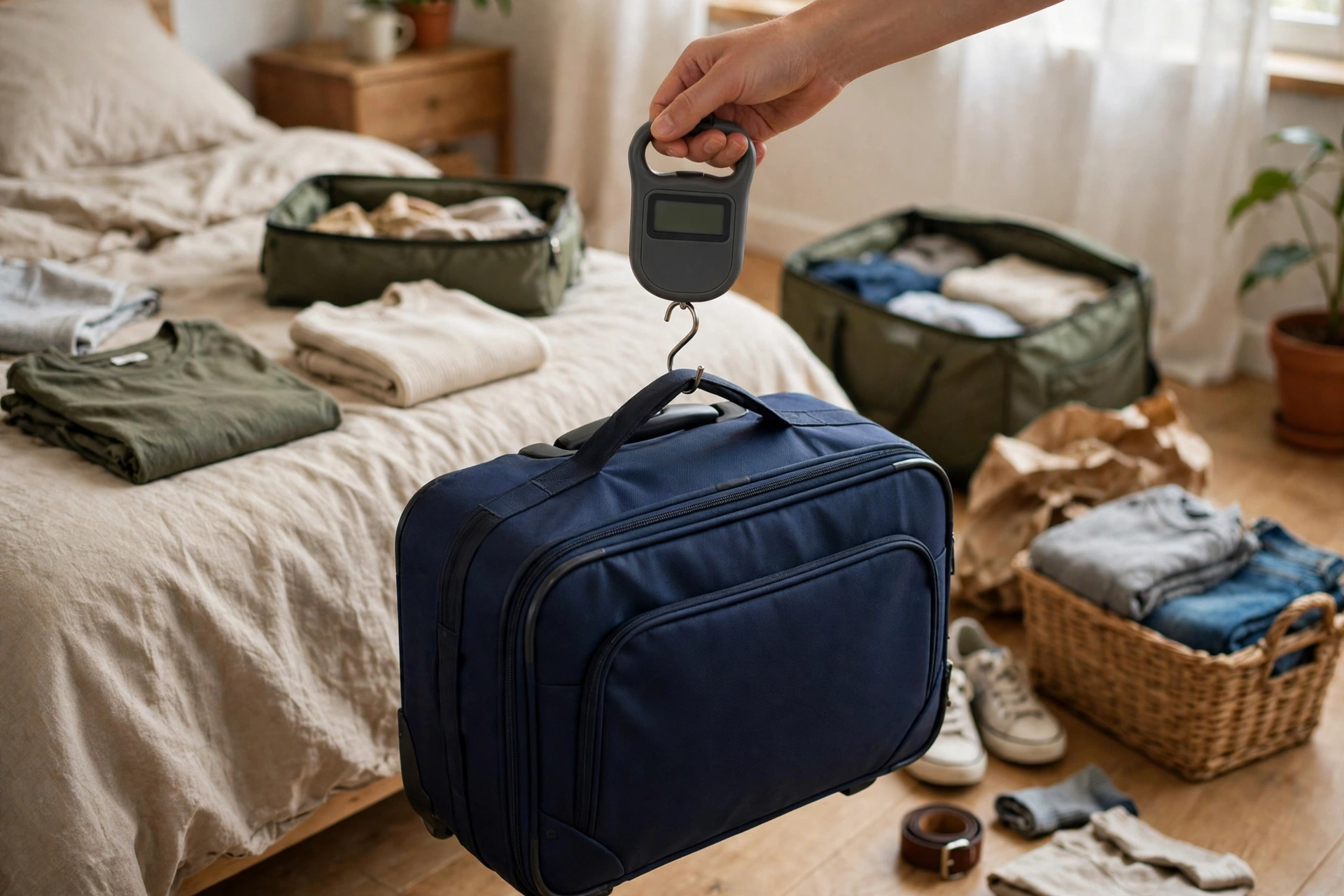
Luggage Weighing Scale India Review: Never Pay Excess Again?
By My Quick Trippers · 21 Oct 2026
7 min read · Travel Gear
Recommended gear
Luggage Weighing Scale — Worth It?
Digital luggage weighing scale
Check 50kg capacity and battery type
As an Amazon Associate, we earn from qualifying purchases. We may earn a commission if you buy through these links, at no extra cost to you.
Honest verdict
for anyone who checks a bag, packs for family trips, or flies low-cost carriers with strict weight limits, this is one of the highest-value travel purchases you can make.
Check Price on AmazonA luggage weighing scale is the cheapest insurance against the most annoying airport moment: the bag that is two kilos over and the repacking session on the terminal floor. At a price band of around ₹400, it costs less than a single excess-baggage charge, and it lives in your bag for every trip after the first. Treat the price band of around ₹400 as approximate — sale prices and seller changes move it either way. My verdict: for anyone who checks a bag, packs for family trips, or flies low-cost carriers with strict weight limits, this is one of the highest-value travel purchases you can make. For cabin-only travellers who never check a bag, it is less essential, but still useful for the one trip a year when you do check. If you are still choosing the bag itself, our Safari Cabin Genius Alley review covers the cabin-size option that most flyers pair with a scale.
Why a 400-rupee gadget saves real money
Excess baggage on Indian domestic flights is charged per kilo, and a single overweight bag can cost more than ten luggage scales. The maths is simple: one avoided fee pays for the scale for life. But the real saving is not money, it is stress. Weighing at home means you pack, check, adjust, and leave with certainty, instead of discovering the problem at the check-in counter with a queue behind you and your clothes spread on the floor. Families benefit most, because family bags are the ones that creep overweight: a child's extra shoes, gifts for relatives, shopping on the way back. A scale turns all of that from a guess into a number. And unlike most travel gadgets, this one has no learning curve, no app, and no subscription — you hook it, lift it, and read the number.
Pros
What it does well
The first win is the price band of around ₹400, which makes this a no-brainer addition to any travel kit. The second win is size: most luggage scales are small enough to slip into a side pocket, so they travel with the bag rather than staying at home. The third win is simplicity: a hook, a handle, and a digital display, with most models reading up to 50kg in both kilos and pounds, which covers every airline allowance you will meet. The fourth win is repeat use: unlike single-trip purchases, a scale gets used before every flight, and then again before the return flight when the bag is heavier with shopping. For frequent flyers, that is dozens of uses a year from a gadget that costs less than a meal at the airport. The honest summary is that this is not an exciting product, but it is one of the rare travel products that pays for itself on the first trip it saves.
Accuracy, capacity, and battery — what to check
Three specs decide whether a luggage scale is useful or frustrating. Capacity matters first: most models read up to 50kg, which covers every checked bag, but check the limit before you buy because a 40kg-capacity scale will error out on a heavy family bag. Accuracy matters second: budget scales are usually accurate to within 100 to 200 grams, which is fine for airline purposes, but test it against a known weight — a 5kg dumbbell or a bag you have weighed on a bathroom scale — so you know whether yours reads high or low. Battery matters third: most scales use a coin cell or AAA batteries, and the annoying failure mode is a dead battery on packing day, so keep a spare cell with the scale and check the display before every trip. The hook design matters too: a wide, smooth hook grips bag handles without slipping, while a narrow hook can slide off a padded handle and drop your bag. Test all four at home, not at the airport.
Cons
Where it falls short — the honest cons
The honest cons are small but worth knowing. First, a handheld scale measures while you lift, which means the reading can wobble if your hand shakes or the bag swings — lift steadily, wait for the number to settle, and take two readings. Second, the scale adds nothing to your bag's weight allowance: it weighs the bag, it does not reduce it, so a bag that is over is still over, and you still have to remove things. Third, cheap scales can drift over time, reading a few hundred grams off after a year of use, so re-check against a known weight occasionally. Fourth, the display can be hard to read in dim light, and some models auto-switch-off too fast while you are still lifting. None of these are reasons to skip the purchase, but they are reasons to buy a scale with a clear display, a stable hook, and a tare function, and to test it before the trip that matters.
Who should buy it — and who should skip it
Buy a luggage scale if you check bags, fly low-cost carriers, travel with family, or shop on your trips — in other words, if your bag weight ever surprises you. Buy it if you have ever paid an excess fee, repacked at the airport, or argued with family about whose shoes put the bag over. Buy it as a gift for anyone who travels: it is cheap, useful, and impossible to get wrong. Skip it only if you genuinely never check a bag and never will, and even then the price band of around ₹400 makes it a reasonable just-in-case purchase. Students moving cities, parents visiting relatives with gifts, and anyone flying home after a shopping-heavy holiday are the core buyers, and for them this is the rare gadget that earns its place in the bag on every single trip.
How to weigh a bag properly
Weighing sounds trivial, but technique changes the number. Hook the scale through the bag's handle, not through a strap that stretches, and lift until the bag hangs freely without touching the floor or your legs. Hold still for three seconds until the display settles, then read it twice — if the two readings differ by more than 200 grams, take a third and use the middle value. Weigh the bag packed exactly as it will fly, including the toiletry kit and the book you will add at the last minute, because last-minute additions are the classic overweight cause. Weigh again before the return flight, when shopping has made the bag heavier, and keep a 500-gram margin below your airline's limit so a different airport scale does not catch you out. Two minutes of weighing at home saves twenty minutes of repacking at the airport, and that trade is worth it every time.
Buying checklist before you order
Check five things before you pay. One, capacity of at least 50kg, so no family bag errors out. Two, a display you can read at arm's length, with both kilos and pounds. Three, the battery type, and whether a spare cell is included or easy to buy. Four, a wide hook that fits padded handles without slipping. Five, a tare or hold function, so the reading stays on screen after you put the bag down. If all five check out, a luggage scale at a price band of around ₹400 is one of the best-value travel purchases in India. If any one fails — a dim display, a narrow hook, a low capacity — pick a different model, because a scale you cannot read or trust is worse than no scale at all.
Share this article