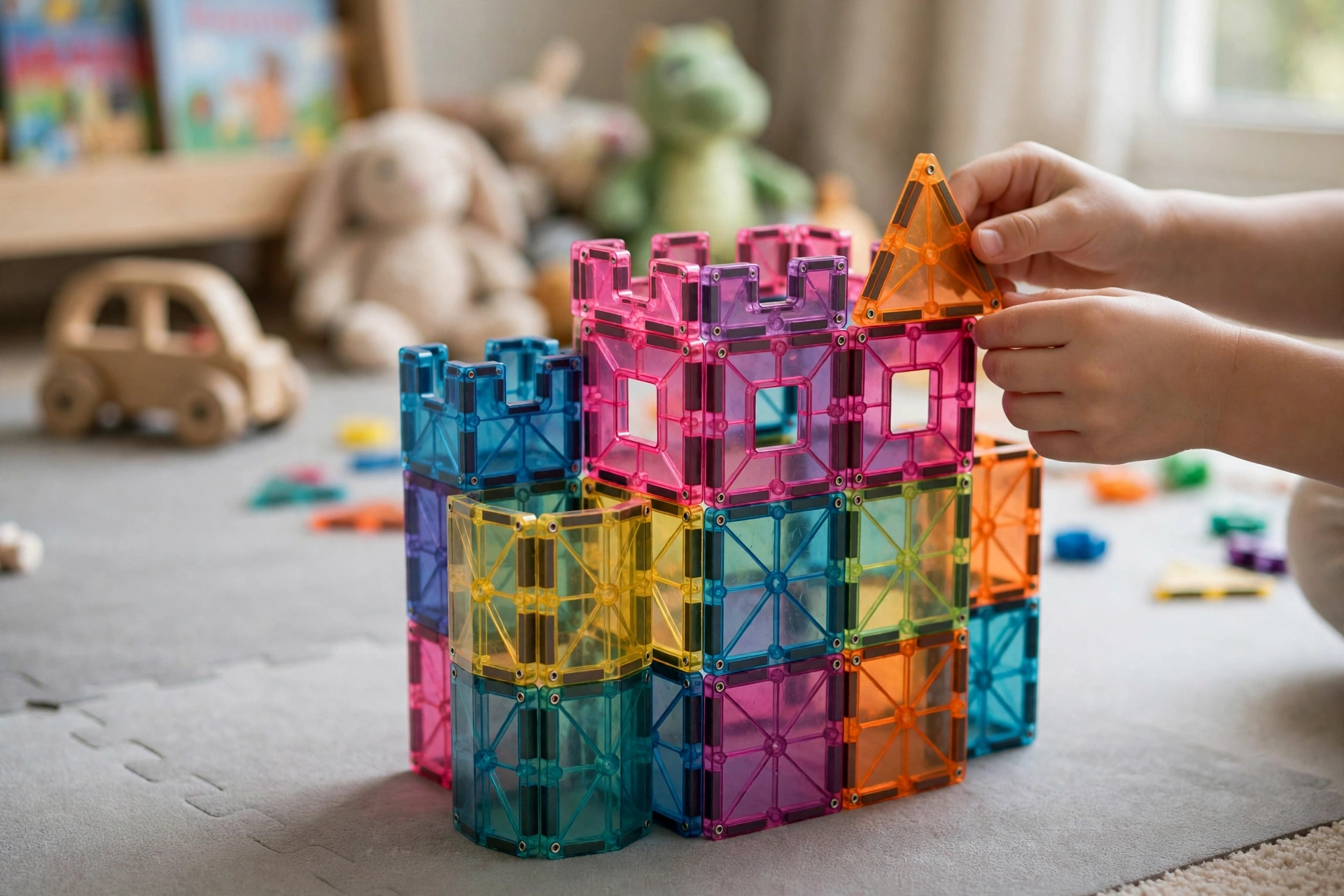
Magnetic Building Tiles India Review: Screen-Free Building?
By My Quick Trippers · 21 Oct 2026
7 min read · Travel Gear
Recommended gear
Magnetic Building Tiles — Worth It?
Magnetic building tiles set
Check magnet strength and piece count
As an Amazon Associate, we earn from qualifying purchases. We may earn a commission if you buy through these links, at no extra cost to you.
Honest verdict
for children aged three and up who like building, magnetic tiles are one of the best-value educational toys available, and industry coverage in 2026 called them one of the fastest-growing educational toy categories in India.
Check Price on AmazonMagnetic building tiles are the rare toy that children play with for years instead of weeks, and that parents do not mind stepping on quite as much as the alternatives. At a price band of around ₹1,100, a starter set of translucent magnetic squares and triangles costs less than a month of app subscriptions, and it builds towers, castles, bridges, and vehicles without a single screen. Treat the price band of around ₹1,100 as approximate — sale prices and seller changes move it either way. My verdict: for children aged three and up who like building, magnetic tiles are one of the best-value educational toys available, and industry coverage in 2026 called them one of the fastest-growing educational toy categories in India. For children under three, or for families that need a toy that packs completely flat, they are less ideal. If you are building out the kids' room as well as the toy shelf, our star projector night lamp review covers the bedtime side of the same room.
Why tiles beat blocks for most kids
Wooden blocks fall down when a tower gets tall, and plastic bricks need exact alignment and finger strength that younger children do not have. Magnetic tiles solve both problems: magnets snap pieces together from any angle, so a three-year-old can build a tall tower that actually stays up, and the satisfaction of a structure that does not collapse keeps children playing longer. The translucent colours add a second layer of play, because tiles on a windowsill or a light table glow, and children learn colour mixing by overlapping tiles. Tiles also scale: a small set builds houses and cars, and a bigger set builds castles and bridges, so the same toy grows with the child instead of being outgrown. The open-ended nature matters most, because there is no instruction manual to finish and no right answer, which is why tiles survive in classrooms and playrooms long after single-purpose toys are forgotten.
What kids actually learn — without it feeling like school
Magnetic tiles teach geometry by stealth: squares, triangles, and rectangles combine into houses, pyramids, and domes, and children learn which shapes make stable structures through trial and error rather than lessons. They teach magnetism itself, because children discover that some sides attract and some repel, and that flipping a tile changes the result. They teach planning, because a big castle needs a wide base and a child who builds narrow first learns why it falls. They teach patience and fine motor control, because placing tiles precisely is a skill, and they teach collaboration, because big builds are more fun with two children. None of this requires a parent to lecture. The learning happens because the toy rewards experimentation, and that is the difference between an educational toy and a toy with an educational label on the box.
Pros
What it does well
The first win is the price band of around ₹1,100, which makes a starter set affordable enough to test whether your child actually likes building before investing in a bigger set. The second win is durability: quality tiles are sealed plastic with magnets inside, they survive drops, they wipe clean, and they do not have small parts that fall off in normal play. The third win is quiet play, because tiles click rather than beep, which matters for parents working from home and for car journeys. The fourth win is compatibility: most magnetic tiles use similar magnet placement, so sets from different brands often work together, letting you expand gradually instead of replacing. For families that want one toy that covers birthdays, holidays, and rainy days, tiles are a strong candidate.
Magnet strength and piece counts — what to check
Magnet strength decides whether towers stand or sag, and weaker magnets are the most common disappointment in budget sets. Strong magnets hold a tall tower upright and let children build bridges and overhangs, while weak magnets limit builds to flat shapes and frustrate older children. Piece count matters differently by age: younger children do well with twenty to thirty pieces, because too many pieces overwhelm, while older children need sixty or more to build anything ambitious. Shape mix matters too: a set that is all squares builds boxes, while a set with triangles, rectangles, and arches builds castles, cars, and bridges. Check whether the set includes wheels or car bases if your child likes vehicles, and check whether the tiles are the standard size, because tiny tiles are fiddly for small hands and do not combine well with full-size sets.
Cons
Where it falls short — the honest cons
The honest cons start with the age limit: magnetic tiles are not for children under three, because loose magnets are dangerous if swallowed, and any set with damaged or cracked tiles must be retired immediately. The second con is the expansion trap: a starter set is affordable, but children who love tiles will want more, and a big collection costs several times the starter price, so the around ₹1,100 band is an entry point, not the total cost of the hobby. The third con is storage: tiles do not stack neatly like blocks, they slide and scatter, and without a box or bag they end up across the floor. The fourth con is that tiles are not a quiet toy in the way parents hope, because towers fall, and falling towers are loud and occasionally upsetting. None of these are deal-breakers, but they are the reasons to buy a sturdy box with the first set.
Age guide — what works at each stage
At three to four, children build flat shapes, simple houses, and short towers, and they need larger tiles with strong magnets and simple shapes. At five to six, children build castles, vehicles, and bridges, and they benefit from triangles, arches, and car bases that let them build beyond boxes. At seven and up, children build ambitious structures, marble runs with tile tracks, and collaborative builds with friends, and they need bigger sets and sometimes a light table to show off translucent colours. The toy grows because the child's imagination grows, which is why tiles last longer than toys with a fixed play pattern. If you are buying for a specific child, match the set to the child's current building level, not to the age on the box, because a confident builder of four will outgrow a toddler set in weeks.
Buying checklist before you order
Check five things before you pay. One, the magnet strength, because weak magnets are the most common regret. Two, the piece count and shape mix against your child's age and building level. Three, the tile size and whether it matches any set you already own, so expansion works. Four, the safety standard and the condition guarantee, because cracked tiles must be replaceable. Five, storage, because a box or bag from day one saves hours of tidying. If all five check out, magnetic building tiles at a price band of around ₹1,100 are a sensible, low-regret purchase that buys years of screen-free building. And keep the receipt and the box for the first month, because a set with a weak magnet or a cracked tile is worth exchanging while the return window is open, and a quick magnet test on arrival, building a tall tower and seeing if it stands, tells you more than any listing claim. If your child is under three, wait, and if your child prefers drawing or reading to building, spend the money on that interest instead.
Share this article