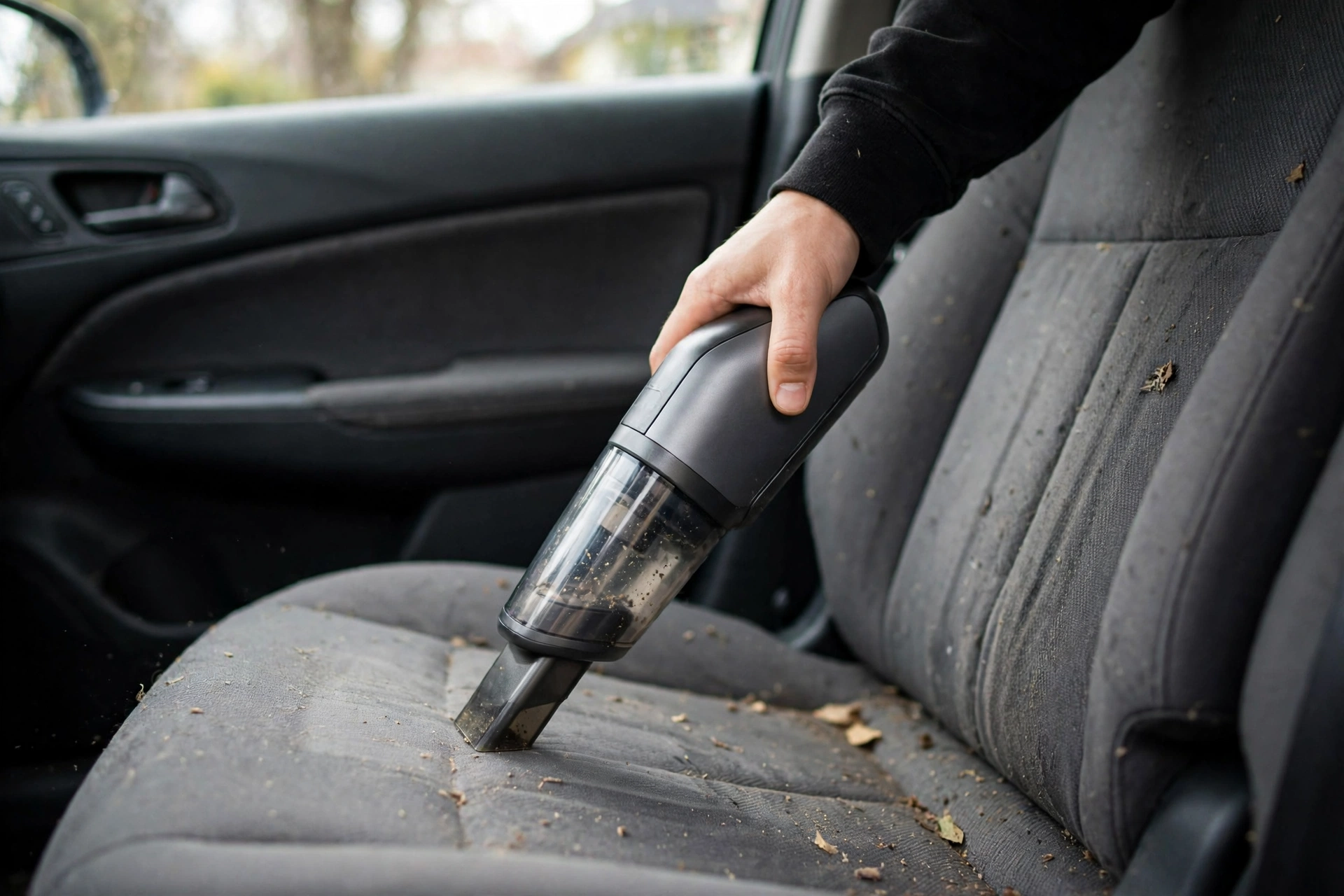
Portable Car Vacuum Cleaner India Review: A Cleaner Cabin?
By My Quick Trippers · 21 Oct 2026
7 min read · Travel Gear
Recommended gear
Portable Car Vacuum Cleaner — Worth It?
Portable car vacuum cleaner
Check suction, battery life, and nozzle set
As an Amazon Associate, we earn from qualifying purchases. We may earn a commission if you buy through these links, at no extra cost to you.
Honest verdict
for anyone with children, pets, or a daily commute that ends in a dusty parking lot, a car vacuum is worth it.
Check Price on AmazonA portable car vacuum cleaner is the tool that decides whether your car stays clean between washes or slowly becomes a dustbin on wheels. At a price band of around ₹1,400, it costs less than two professional interior cleanings, and it lives in your boot for the biscuit crumbs, the beach sand, and the pet hair that otherwise accumulate for months. Treat the price band of around ₹1,400 as approximate — sale prices and seller changes move it either way. My verdict: for anyone with children, pets, or a daily commute that ends in a dusty parking lot, a car vacuum is worth it. For drivers whose cars rarely get dirty, it is a nice-to-have rather than a need. Car accessories including vacuum cleaners are named among Amazon India's automotive best-seller strengths, which tells you this is a category Indian car owners buy in volume — and the honest review is about suction and battery, not brand.
Why a car vacuum beats a home vacuum for cars
A home vacuum is powerful but wrong-shaped for a car: it is bulky, needs a wall socket, and cannot reach under seats, into door pockets, or between seat rails. A portable car vacuum is small, battery-powered, and shaped for car gaps, with nozzles for crevices, brushes for seats, and an extension for the boot. The practical difference shows up in the jobs that matter: crumbs between seats, dust on the dashboard, sand in the footwells, and pet hair on fabric seats, all of which a home vacuum either cannot reach or cannot power conveniently. Cordless car vacuums add a second advantage: you clean the car where it is parked, without dragging a cable from the house or running the car for power. The trade is suction: a portable vacuum will not match a full-size home vacuum, so it is a maintenance tool for regular cleaning, not a rescue tool for a car that has not been cleaned in a year.
Pros
What it does well
The first win is convenience: a cordless vacuum in the boot means a five-minute clean whenever the car needs it, instead of a planned cleaning session. The second win is reach: crevice tools and brushes get into the gaps where dust actually lives, which is why a car cleaned with the right nozzles looks cleaner than one cleaned with a powerful but blunt tool. The third win is the price band of around ₹1,400, which buys a usable cordless cleaner rather than a toy. The fourth win is versatility: the same device cleans the car, the sofa edges, the keyboard, and the stairs, so it earns its space beyond the garage. The fifth win is habit: when cleaning is easy, it happens often, and a car cleaned weekly never reaches the state where it needs a professional detail. For a driver who values a clean cabin, that habit shift is the real product.
Suction, battery, and dustbin — what to check
Three specs decide whether a car vacuum is useful or a toy. Suction matters first: check the rated suction or air watts rather than the marketing, and remember that a vacuum that cannot lift sand from a footwell mat is decoration. Battery matters second: a cordless vacuum should clean a whole car on one charge, roughly fifteen to twenty minutes of real use, and a battery that dies halfway through the back seat is the most common frustration. Dustbin size matters third: a tiny bin fills after one seat and needs emptying constantly, so a larger, washable bin with a simple emptying mechanism saves time and mess. Also check the nozzle set: a crevice tool for gaps, a brush for seats, and an extension hose for the boot cover the real jobs. And check the filter: a washable filter beats a replaceable one on running cost, and a clogged filter is the most common reason a vacuum slowly loses suction.
Cons
Where it falls short — the honest cons
The honest cons start with power: at a price band of around ₹1,400, you are getting a maintenance cleaner, not a deep-cleaning machine, so ground-in dirt, wet stains, and a year of neglect will still need a professional. The second con is battery fade: lithium batteries lose capacity over years, and a vacuum that cleaned the whole car new may manage half a car after two years of boot heat. The third con is noise: small motors are loud in a closed car, and a full clean is not a quiet job. The fourth con is the bin: small bins mean frequent emptying, and emptying a dusty bin in a parking lot is its own mess. None of these are deal-breakers for a maintenance tool, but they are the reasons to keep expectations honest: a portable vacuum keeps a clean car clean, it does not resurrect a dirty one.
Who should buy it — and who should skip it
Buy a portable car vacuum if you have children, pets, or a commute that ends in dust, because those are the cars that get dirty fastest. Buy it if you eat in the car, carry sports gear, or drive on unpaved roads. Buy it if you have ever paid for an interior cleaning and thought the result was mostly vacuuming anyway. Skip it only if your car genuinely stays clean, you already own a small handheld vacuum that reaches car gaps, or you prefer paying for professional cleaning — and even then, the price band of around ₹1,400 makes it a reasonable experiment. Parents, pet owners, and daily commuters are the core buyers, and for them a car vacuum is one of those purchases that quietly improves every week.
A five-minute car-clean routine
The routine that works is short and regular. Start with the footwells: remove the mats, shake them outside, and vacuum the floor beneath. Then the seats: a brush pass over fabric seats lifts crumbs and hair, and a crevice pass along the seat edges gets what the brush misses. Then the dashboard and door pockets: a soft brush pass for dust, without pressing hard on screens or vents. Then the boot: a quick pass over the carpet and into the corners. Empty the bin, tap out the filter, and put the vacuum back in the boot. Five minutes, once a week, and the car never reaches the state where cleaning feels like a project. The secret is not the vacuum, it is the routine — but a vacuum that lives in the boot is what makes the routine possible.
Buying checklist before you order
Check five things before you pay. One, suction strong enough for sand and pet hair, not just surface dust. Two, battery life of at least fifteen minutes of real use, so one charge covers the whole car. Three, a washable filter and a bin you can empty without a mess. Four, the nozzle set: crevice tool, brush, and extension for the real jobs. Five, size and weight that fit your boot and your hand, because a vacuum that is awkward to hold will not get used. If all five check out, a portable car vacuum at a price band of around ₹1,400 is a sensible cabin investment. If any one fails — weak suction, short battery, a fiddly bin — pick a different model, because a vacuum that frustrates you will stay in the boot unused.
Share this article