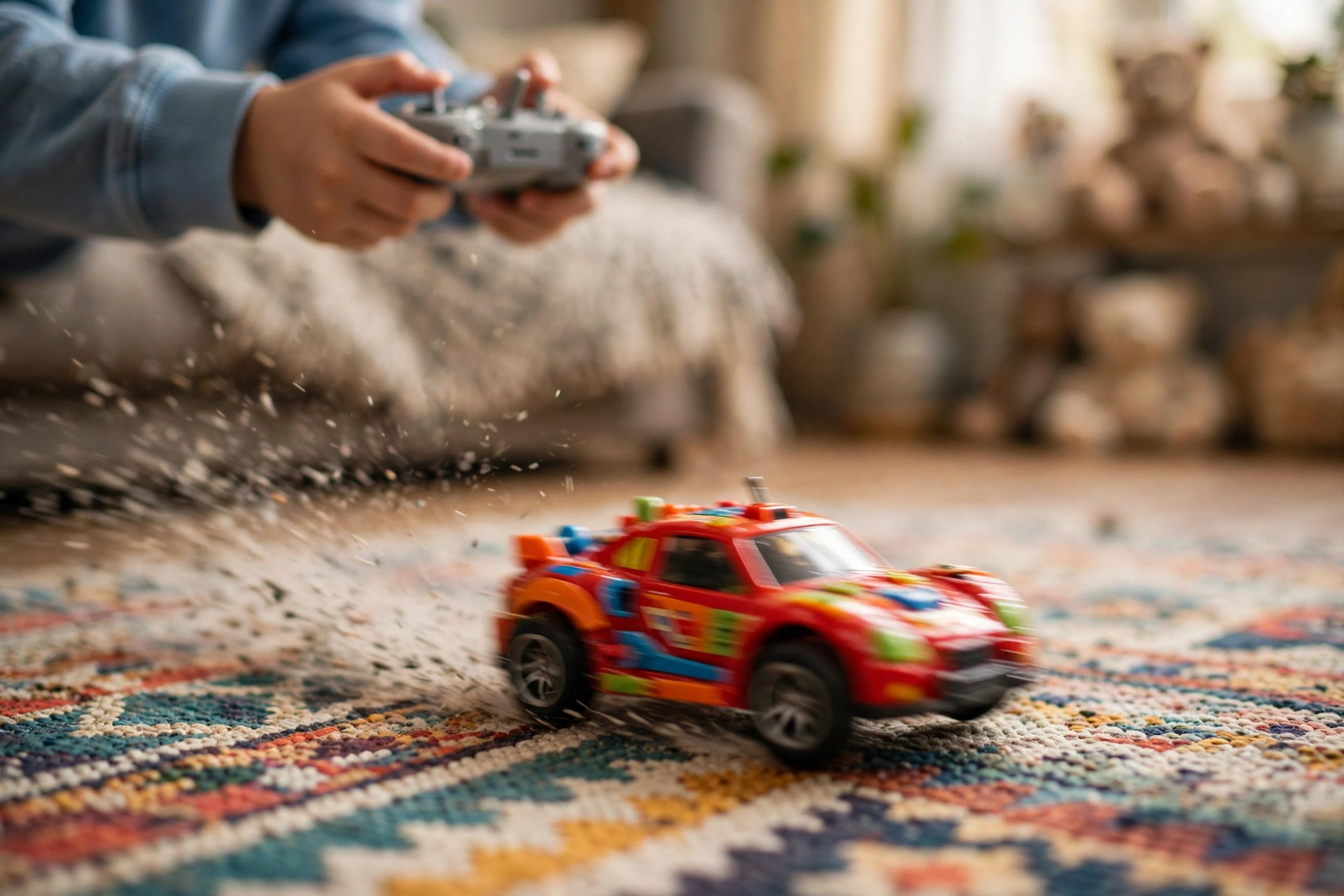
Remote Control Car for Kids India Review: First RC Car?
By My Quick Trippers · 21 Oct 2026
7 min read · Travel Gear
Recommended gear
Remote Control Car for Kids — Worth It?
Remote control car for kids
Check play time and charge time first
As an Amazon Associate, we earn from qualifying purchases. We may earn a commission if you buy through these links, at no extra cost to you.
Honest verdict
for children aged four and up who like vehicles and outdoor play, a first RC car is a strong gift, and South India toy sales data published in October 2026 put remote-control cars among the highest-volume toy categories.
Check Price on AmazonA remote control car is the toy that turns a living room into a racetrack and a garden into an off-road course, and it is the rare gift that delights a five-year-old and a twelve-year-old for different reasons. At a price band of around ₹1,100, a first RC car costs less than a family pizza night, and it teaches steering, speed control, and spatial thinking without a single screen. Treat the price band of around ₹1,100 as approximate — sale prices and seller changes move it either way. My verdict: for children aged four and up who like vehicles and outdoor play, a first RC car is a strong gift, and South India toy sales data published in October 2026 put remote-control cars among the highest-volume toy categories. For toddlers, or for families with no outdoor space at all, it is less ideal. If your child is ready for a proper off-road machine, our 4x4 RC rock crawler review covers the tougher end of the same hobby.
Why RC cars never go out of fashion
Remote control cars have survived every toy trend because they give children real control over a real moving object, which no screen game replicates. Steering a car around furniture, judging speed through a doorway, and recovering from a crash are physical skills that build hand-eye coordination and spatial awareness, and the immediate feedback — the car does exactly what your thumbs tell it — is deeply satisfying for children. RC cars also scale with age: a young child enjoys simply driving in circles, an older child builds obstacle courses and races friends, and a teenager starts caring about speed, suspension, and battery life. The toy also gets children outside, because a garden, a park, or a quiet lane is a better track than any living room, and outdoor play is the part parents value most. That combination of control, skill, and fresh air is why RC cars keep selling while other toys fade.
Types — on-road, off-road, and crawler
On-road cars are fast, low, and built for smooth floors and pavements, and they suit children who like racing and speed. Off-road buggies and monster trucks have bigger wheels, higher ground clearance, and tougher bodies, and they suit gardens, parks, and rough ground where on-road cars get stuck. Crawlers are slow, torquey machines built to climb rocks, stairs, and obstacles rather than race, and they suit children who like technical driving and problem-solving more than pure speed. Scale matters too: smaller cars suit indoor play and younger children, while larger cars handle outdoor terrain better but need more space and stronger batteries. For a first car, an off-road buggy or a small monster truck is the most forgiving choice, because it works on more surfaces and survives more crashes than a low, fast on-road car.
Pros
What it does well
The first win is the price band of around ₹1,100, which makes a first RC car a genuine gift rather than a major purchase, and a breakage does not feel like a disaster. The second win is skill building: steering, throttle control, and spatial judgement all improve with play, and children learn cause and effect in a way that is immediately visible. The third win is social play, because RC cars are more fun with friends, and races, obstacle courses, and shared tracks turn solo play into group play. The fourth win is outdoor time, because the best RC driving happens outside, and a car that pulls a child into the garden is doing something no tablet does. For birthdays and festivals, an RC car is also one of the safest crowd-pleasing gifts, because almost every child who receives one plays with it the same day.
Battery and range reality — read this before you buy
Battery life is where budget RC cars disappoint, because a car that runs for fifteen minutes and charges for two hours frustrates children fast. Check the play time and the charge time separately, and look for cars with USB charging, which is convenient, or with replaceable batteries, which let you swap and keep playing. Range matters too: a car that only works within ten metres of the controller is an indoor toy, while a car with thirty metres or more of range works properly outdoors. Controller type matters as well: simple two-button controllers suit young children, while pistol-grip controllers with a steering wheel suit older children and give finer control. The honest rule is that a car with a spare battery, or a car whose battery charges fast, gets played with twice as much as a car that spends most of its life plugged in.
Cons
Where it falls short — the honest cons
The honest cons start with breakage: budget RC cars have plastic parts that crack on hard crashes, and wheels, bumpers, and aerials are the usual casualties, so a first car should be judged on toughness, not top speed. The second con is the battery cycle already described: short play times and long charges are the most common reason RC cars end up in cupboards. The third con is space: a fast car in a small flat is a recipe for broken vases and annoyed parents, so families without outdoor space should choose a slower, smaller car. The fourth con is the upgrade path: children who love RC cars will want faster, tougher cars, and the around ₹1,100 band is an entry point, not the end of the hobby. None of these are reasons to skip the purchase, but they are reasons to buy tough and slow for a first car, not fast and fragile.
Age and safety guide
At four to five, children need a slow, tough car with a simple controller and big buttons, and they should drive indoors or in a safe garden under supervision. At six to eight, children handle faster cars, pistol-grip controllers, and outdoor tracks, and they start racing friends and building courses. At nine and up, children want speed, off-road capability, and sometimes the crawler style of technical driving, and they can manage battery care and basic maintenance. Safety rules apply at every age: never drive near roads, never drive at pets or people, check the car for loose parts after crashes, and keep small batteries away from younger siblings. The controller's batteries matter too, because a car that eats through controller cells quickly becomes expensive, so rechargeable controller batteries are worth considering for heavy players.
Buying checklist before you order
Check five things before you pay. One, the car type against where it will actually be driven, because an on-road car in a garden is a stuck car. Two, the play time and charge time, because battery reality decides how much the car gets used. Three, the toughness, especially bumpers and wheels, because first cars crash a lot. Four, the controller type against the child's age and hand size. Five, whether spare batteries or parts are available, because a car you cannot repair is a car you throw away. If all five check out, a remote control car for kids at a price band of around ₹1,100 is a sensible, low-regret gift that buys outdoor play and real driving skill. If your child is under four, wait a year, and if you have no safe outdoor space, choose a slower indoor car instead.
Share this article