Sandakphu-Phalut Autumn Trek: The 2026 Season Guide
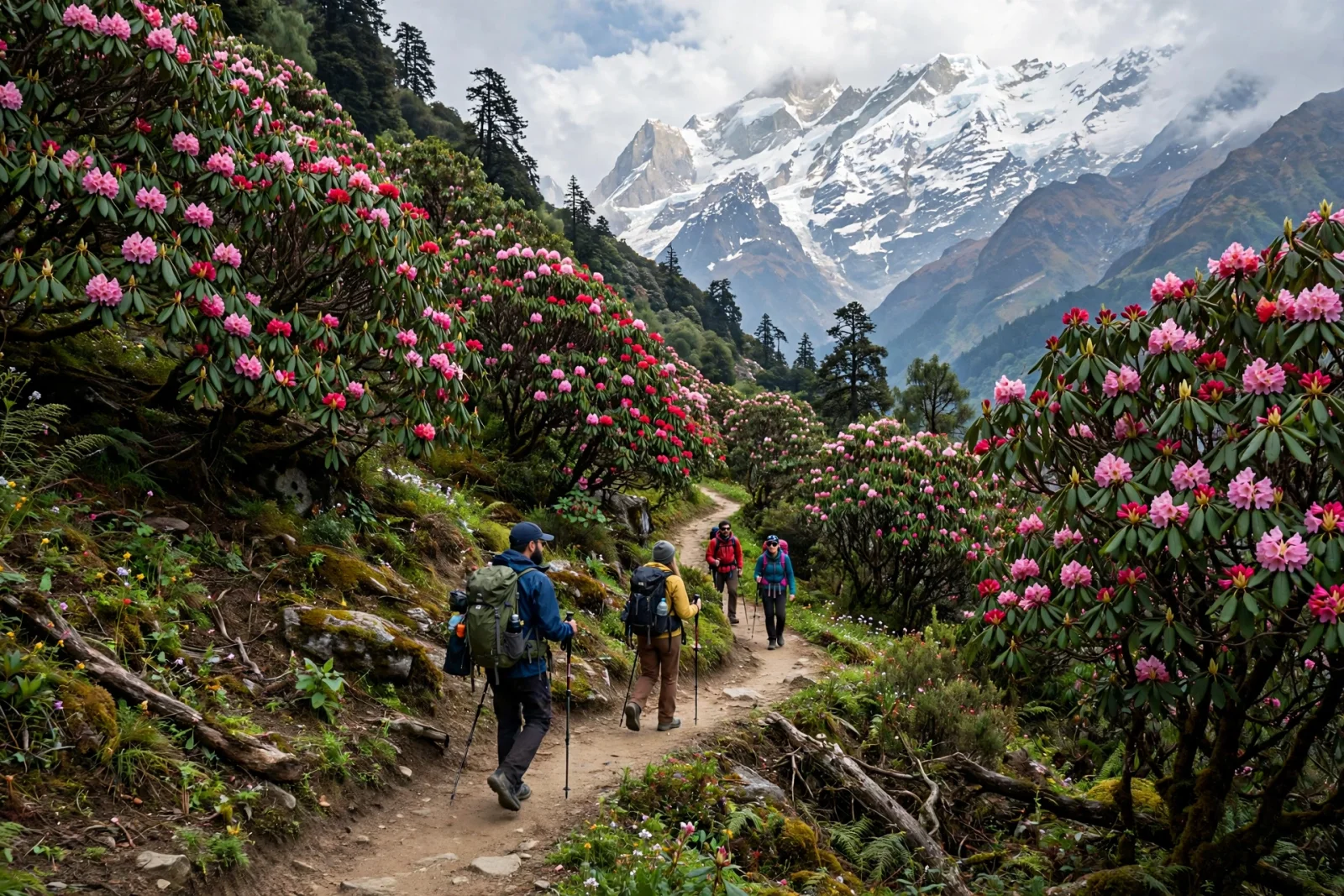
From one ridge in West Bengal, you can stand at sunrise and see four of the world's five highest mountains — Everest (8,848 m), Kanchenjunga (8,586 m), Lhotse (8,516 m) and Makalu (8,485 m) — lined up in a single horizon, with the Kanchenjunga massif arranged into the famous Sleeping Buddha silhouette. That ridge is Singalila, and the trek along it from Sandakphu (3,636 m) to Phalut (3,600 m) is India's most accessible big-Himalaya autumn walk. October to early December is the clearest window of the year — the monsoon has washed the air clean and the ridge sits above the haze — which makes this, not the crowded spring rhododendron season, the flagship trekking month. Here is the 2026 season guide: the classic 6–7 day route from Manebhanjan, permits and guide rules, the Phalut decision, and what October actually feels like on the ridge.
Why October is the clearest window of the year
The view is the whole point of this trek, and the view is weather. In July the same trail shows you cloud; in October, post-monsoon air gives the sharpest long-range visibility of the year, with the four 8000-metre peaks and the Sleeping Buddha — Jannu (Kumbhakarna) as the head, Kanchenjunga as the torso, Pandim as the feet — holding steady at dawn. Day temperatures run roughly 12 to 20 degrees on the trail, nights drop toward and below freezing from November, so October is the sweet spot: crisp without being brutal. The trade-off is demand — October weekends fill the teahouses, so weekday starts and pre-booked trekkers' huts are the smart play.
The classic 6–7 day Manebhanjan route
- Day 1: Drive NJP/Bagdogra to Manebhanjan (~1,980 m) or Chitrey — 90–100 km, 4–5 hours. Permits and guide formalities at the forest office.
- Day 2: Trek Manebhanjan → Tonglu/Tumling (~2,900 m) via Chitrey and Meghma — about 9–13 km, 5–6 hours. First ridge views.
- Day 3: Trek via Gairibas to Kalipokhri (~3,100 m) — about 12–13 km, 6–7 hours. The pond with dark water the village is named for.
- Day 4: Trek Kalipokhri → Sandakphu (3,636 m) — 6 km, 3–4 hours. The classic sunrise viewpoint over the four giants.
- Day 5: Trek Sandakphu → Phalut (3,600 m) — 21 km along the ridge, 8–9 hours. The longest, loneliest, arguably finest day: Nepal on one side, West Bengal on the other, and Phalut's wider, crowd-free panorama at the end.
- Day 6: Trek Phalut → Gorkhey (~2,260 m) — 15 km downhill through silver fir forest to a lovely stream-side village.
- Day 7: Trek Gorkhey → Srikhola, then drive to NJP/Bagdogra (or Darjeeling, 90 km/4 hours). Trek ends.
Total trekking distance runs 65–75 km depending on start and end points. The trail doubles as the Land Rover track, which is part of its character — and a genuine safety net, since you can be driven out at almost any point, unusually good for a Himalayan trek. Detailed seasonal route notes are covered well in this 2026 Sandakphu-Phalut trek guide.
“you can stand at sunrise and see four of the world's five highest mountains — Everest (8,848 m), Kanchenjunga (8,586 m), Lhotse (8,516 m) and Makalu (8,485 m) — lined up in a single horizon”
Permits, guides and the 2026 rules
You need a Singalila National Park entry permit plus a forest area permit, both issued at the forest office in Manebhanjan — carry government photo ID at all times, and foreign nationals need passport copies, visa copies and photos, with stricter overnight-stay rules on the Nepal side of the ridge. A registered guide is mandatory inside the national park; solo trekking without one is not permitted. For 2026, pre-booking trekkers' huts through a registered local agency is effectively mandatory because of park capacity limits — independent trekkers are facing permit issues, so do not show up unbooked in October.
Expect teahouse life, not camping, on the classic route: dorm-style bunks or twin beds, thin blankets (bring a sleeping-bag liner), squat toilets, and basic vegetarian food — dal, rice, noodles, eggs, endless tea. Electricity is solar and limited; carry a 20,000 mAh power bank. The Phalut night is the most basic — the government trekkers' hut has no electricity — and also the most memorable, so pack a headlamp and warm layers for the pre-dawn walk to Phalut Top for sunrise. This honest first-hand breakdown of trek logistics covers the teahouse reality well.
Should you go to Phalut, or turn back at Sandakphu?
Turning back at Sandakphu gives you a 4–5 day trek and the classic four-peak sunrise. Continuing to Phalut adds roughly one day each way and asks for one very long day (the 21 km ridge walk). The payoff: Phalut is quieter, its panorama is arguably wider and wilder than Sandakphu's, and the Sleeping Buddha alignment reads even better from there.
If your schedule allows six to seven days total, go to Phalut — the Sandakphu-only version leaves the best day of the ridge on the table. The pre-dawn climb to Phalut Top is the trek's finest hour: arrive in the dark, watch the Everest group catch fire first, then the Sleeping Buddha emerge ridge by ridge as the light spreads. If you are short on time or the long day worries you, the shorter version is still one of the great Himalayan views. Either way, train for it: four weeks of 5–10 km daily walks before the trek, broken-in boots with grip (much of the track is rough concrete and loose stone), a genuinely windproof shell, and thermal base layers.
Getting there and when to book
Fly to Bagdogra (IXB) or take the train to New Jalpaiguri (NJP), then drive up to Manebhanjan — roughly 90–100 km and four to five hours, usually via Darjeeling, which at 28 km away is the last town with a hospital, pharmacy and dependable ATMs. Most operators assemble in Darjeeling or NJP and drive up as a group. For October 2026, book your operator and huts now — the autumn window is short and the ridge has finite beds.
If your dates are flexible, the first week of November is quieter with equally sharp views. Pair the trek with two days in Darjeeling for Tiger Hill sunrise and the toy train, and you have the perfect Himalayan week.
Frequently Asked Questions
What is the best month for the Sandakphu-Phalut trek?
October to November for crystal-clear Himalayan views, and March to May for rhododendron bloom. Avoid June to September (monsoon). October is the single clearest window of the year.
Can you really see Everest from Sandakphu?
Yes. On clear days you see Everest, Kanchenjunga, Lhotse and Makalu — four of the world's five highest peaks — in one horizon, plus the Sleeping Buddha silhouette of the Kanchenjunga range.
What permits are needed for the Sandakphu trek?
A Singalila National Park entry permit and a forest area permit, issued at Manebhanjan, plus a mandatory registered guide. In 2026, pre-booking trekkers' huts via a registered local agency is effectively mandatory due to park limits.
How difficult is the Sandakphu-Phalut trek?
Easy to moderate. Maximum altitude is 3,636 m, daily walking is 5–7 hours, and the trail gains height slowly with a road out at almost every point. The Sandakphu-to-Phalut day (21 km, 8–9 hours) is the toughest.
Is Phalut worth the extra days?
If you have 6–7 days, yes — Phalut's panorama is wider, quieter and arguably the finest viewpoint on the ridge, with the best Sleeping Buddha alignment.
Sources
- Trek In Sikkim — 2026 Sandakphu-Phalut trek guide
- MadClub — first-hand breakdown of trek logistics
- Outlook Traveller — What Is It Like To Trek To Sandakphu, West Bengal?
Share this article