Shimla and Kufri Winter School Trip Guide from Chandigarh: Heritage, Town Planning and Snow Observation
By My Quick Trippers · 22 Oct 2026
15 min read · Destination Guides
A Shimla school trip from Chandigarh is the most practical winter school journey in Himachal, and this guide is honest about why: it is close enough for a short programme, rich enough in heritage and town planning to justify a school's time, and cold enough in winter to teach winter geography properly — without needing snow to be worthwhile. That last point is the whole planning principle for this trip. Snowfall is never guaranteed, no snow activity is promised, and the Kufri day is weather-dependent from the start, with a town-based fallback agreed before departure. A school that plans Shimla this way gets a good trip on a clear, cold, snow-free weekend, and a bonus if snow happens to fall while conditions remain safe. A school that plans it the other way round — snow first, everything else as filler — risks having to explain a disappointing trip to parents. This guide sets out a 2-night, 3-day winter programme built around colonial heritage, town planning, museums, the Himalayan Nature Park at Kufri, and winter snow observation only where weather and safety allow it.
Snow honesty first: what winter in Shimla can and cannot promise
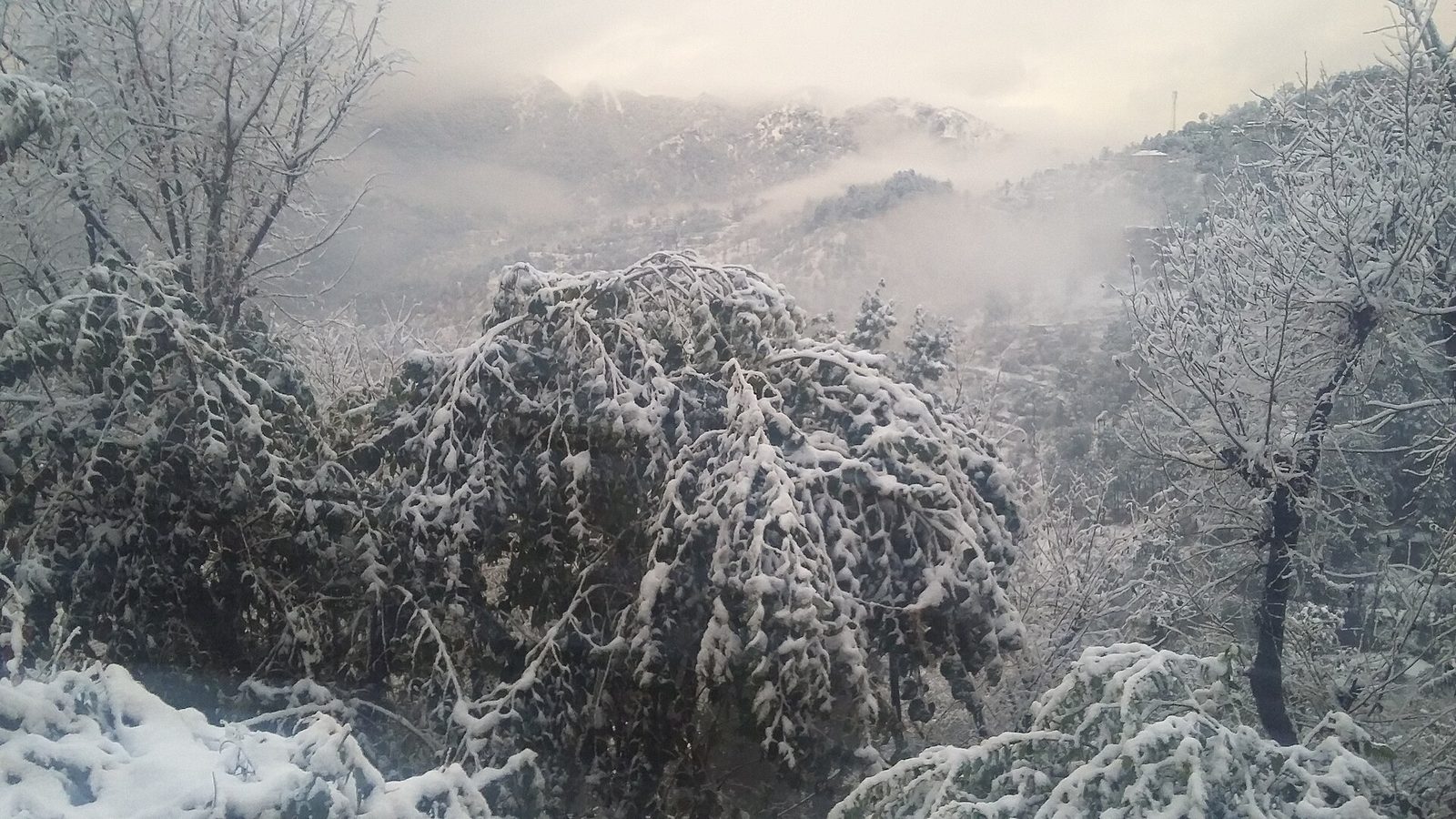
Shimla in winter is cold, often clear, and sometimes snowy, and only the first two of those can be planned around with any confidence. Snowfall depends on a particular weather system arriving at the right time, and even when it falls, road conditions, ice, and visibility decide whether a higher stop such as Kufri is reachable that day. No brochure, itinerary, or operator should promise a school snowfall, a snow activity, or a snow-covered Kufri on a chosen date, and parents should never be charged for a trip whose main selling point is a weather event nobody controls. The hero photograph for this post shows snow-covered trees and hills in Shimla; it is a historic actual winter photograph, not a picture of current conditions and not a promise that any school group will see the same scene. Winter still teaches plenty without snow: bare trees reveal slope, rock, and building structure that summer foliage hides; cold air makes clothing, warmth, and energy use a lived lesson; and shorter days force the tighter planning that is itself good fieldwork discipline.
The practical consequence is a two-track itinerary, agreed before departure. Track one is the town programme in Shimla itself, which runs in almost any winter weather: heritage walks, town-planning fieldwork, and museum visits where opening conditions allow. Track two is the Kufri day, which runs only if weather, road conditions, and the school's risk process all allow it on the day. If track two cannot run, the group does more of track one — a second heritage morning, map work, museum study, or a structured reflection session — and the day remains a learning day. Teachers should also confirm, before booking, who makes the Kufri go-or-no-go decision and when: the answer should be the accompanying teachers, on the morning of the day, using current road and weather information, not a timetable fixed weeks earlier. For destination context, see Shimla, Kufri, and the Himachal destination overview.
A realistic 2-night, 3-day winter pacing from Chandigarh
Day 1 is a travel and first-heritage day. The group departs from its school in Chandigarh in the morning, travels to Shimla in daylight, settles into accommodation, and uses the remaining daylight for a short, supervised heritage walk — enough to orient students to the ridge, the main town spine, and the layout they will study properly on Day 2, without asking tired travellers to do serious fieldwork. The evening is kept for settling in, a warm meal, and an early night, because winter days are short and the next morning starts early. Day 2 is the main field day: a full heritage and town-planning morning in Shimla, a museum visit where opening conditions allow, and the Kufri excursion in the afternoon only if weather and road conditions allow it, with the town fallback ready if they do not. Day 3 is a shorter morning — a final field task, group presentations, or a second museum or heritage stop — followed by the return to Chandigarh in daylight, with rest stops planned and no promise of a late-evening hill arrival.
A school with a third night gains something real: the Kufri decision can be moved to the better of two days, and the town fieldwork can be spread over two unhurried mornings instead of one crowded one. That relaxed 3-night, 4-day version is worth recommending to any school whose timetable allows it, and it is a better use of an extra night than adding a distant second town to the route. A school with only one night, by contrast, should think carefully: a single-night Shimla trip from Chandigarh spends most of its time travelling and leaves almost no time for the heritage and planning fieldwork that justifies a school journey. Group planning follows the wider school programme: a minimum of 10 students, with bands of 10, 20, 50 and more, and planned supervision at one accompanying teacher per 10 students, as set out in the supervision section below. On timing, note that one Chandigarh school's calendar — AKSIPS-45, whose 2026–27 calendar shows a winter break from 31 December 2026 to 11 January 2027 — is one school's calendar only, not a universal Chandigarh holiday schedule; every school must plan around its own calendar, exam schedule, and term dates.
Shimla heritage: a town you can read like a textbook
Shimla's colonial heritage is unusually legible for school fieldwork, because the town's history is written into its layout. Students can walk the ridge spine, identify the older core and the later spread down the slopes, and discuss why a hill town built as a summer capital grew along a ridge rather than across a valley floor. Building styles and materials add a second layer: older public buildings, churches, and institutional architecture can be compared with later commercial and residential building, and students can record how each sits on the slope, what it is made of, and what it was built for. A good field exercise is the annotated sketch used elsewhere in this series: each student draws one street or slope scene, labels five features, and writes one sentence explaining why one feature is where it is. It needs no equipment, it cannot be copied from a phone, and it shows the teacher immediately who observed and who merely looked.
Heritage here also means behaviour, not just buildings. Students should be taught before arrival that Shimla is a living town, not an open-air museum: residents live and work along the same streets the group walks, places of worship are used for worship first, and photography, noise, and group movement should respect that. Teachers can turn that into a lesson by asking students to notice who uses each part of town and for what — residents, shopkeepers, workers, and visitors — and to compare the main commercial spine with a quieter residential slope. That observation, recorded in field notebooks, teaches town geography more honestly than any list of famous buildings. For a fuller treatment of heritage fieldwork as a learning activity, see our guide to learning activities for school trips in Uttarakhand and Himachal.
Town planning and museums: the classroom half of the trip
Town planning is the subject that makes Shimla more than a pretty walk, and it can be taught with two simple tools: a map and a question. Give each small group a town map and ask it to mark the ridge, the main spine, the older core, and the newer spread, then to propose one reason why each area grew where it did — slope, road, water, or an old administrative decision. Groups then compare maps, and the differences between them become the discussion. That exercise works in a classroom before departure, in the field, and again afterwards, which makes it the most reusable field task on this trip. Museum visits support the same learning where they are open on the day: a museum gives students objects, models, and displays that anchor the town's history in something concrete, and a good museum task is to choose one exhibit, explain it in the student's own words, and note one question it left behind. Museums are included only where opening days and group conditions allow, and are never presented as guaranteed entry.
Winter adds a planning dimension that teachers should name explicitly for students: how does a hill town cope with cold, short days, and occasional snow? Students can observe heating, insulation, water supply, and road maintenance as town-planning questions, not just as background. A group that notices how a hillside settlement keeps its roads usable, its water flowing, and its buildings warm in January has learned applied geography, and that learning works whether or not snow falls during their visit. This is the right place to repeat the trip's central rule in terms students understand: the trip is designed to be a good trip with no snow at all, and any snow is an extra, not a rescue. Teachers who explain that rule to parents before departure protect the school from the one disappointment that a winter itinerary can most easily create.
Kufri: Nature Park and winter snow observation, weather permitting only
Kufri, as a Shimla satellite, adds two things the town itself cannot: a nature-park and forest-trail stop, and higher ground where winter conditions — cold air, frost, and, sometimes, snow — can be observed directly. The Himalayan Nature Park element suits a school group well when it is open and conditions allow: students can observe Himalayan fauna and forest habitat in a managed setting, practise quiet observation, and discuss why a nature park exists, what it protects, and how it differs from a wild forest. The snow-observation element, by contrast, is entirely conditional. Where snow has fallen and conditions are safe, students can observe snow depth, study crystals with a hand lens, and discuss insulation and adaptation — a wonderful bonus lesson. Where there is no snow, or where roads or ice make the trip unsafe, the Kufri day does not run, and the town fallback runs instead. No snow activity of any kind is promised, and no activity is sold to parents as a guaranteed snow experience.
Safety on the Kufri day is decided by conditions, not by enthusiasm. Teachers should check road and weather information on the morning of the day, confirm that the route is open and safe for a school coach, and keep the group together on marked paths and viewing points, with clear boundaries set before anyone leaves the vehicle. Warm clothing, gloves, and suitable footwear are not optional extras in winter: the planning checklist for the trip should treat them as required kit, and teachers should check kit before the coach leaves Shimla, not after it arrives at a cold, exposed stop. A group that arrives warm, dry, and briefed can learn in cold weather; a group that arrives cold and unprepared cannot, whatever the view. That is why the Kufri fallback matters so much: it is not an admission of failure, it is the plan working as designed, and students should be told so in advance.
Winter safety, clothing, and daylight: the practical half of the plan
Winter safety for a Shimla school trip is mostly a matter of daylight, warmth, and roads, and all three should be planned before departure. Shorter days mean earlier starts, tighter schedules, and no field task planned for after dark; teachers should build the day around the available daylight and protect an early return to accommodation. Warmth means layered clothing, warm footwear, gloves, and hats as required kit, plus warm-up time built into the schedule — students who are cold stop learning, and a short indoor warm-up is a better use of twenty minutes than a further twenty minutes of shivering observation. Roads mean checking conditions close to departure and again each morning, planning rest stops in daylight, building driver rest into the schedule, and never planning night driving on hill roads as the default. A winter planning checklist helps with all of this, and teachers may find our winter school trip planning checklist for Chandigarh schools useful for packing, permissions, and risk-assessment preparation.
Two further winter cautions deserve explicit mention. First, ice: a clear, cold morning after overnight frost can make paths and steps slippery even when the road itself is open, so teachers should brief students on careful walking, suitable footwear, and staying on treated or main paths. Second, change: winter weather in the hills can change during a day, so the accompanying teachers should keep checking conditions and be willing to shorten or move an outdoor session. Neither caution is a reason to avoid a winter trip — Shimla in winter, planned this way, is an excellent school journey — but both are reasons to plan it as a weather-aware trip rather than a fixed-route tour. The school's risk process, not the itinerary document, is the final authority on every such decision, and this guide is a planning aid, not a substitute for that process.
Supervision, safeguarding, and what the school must confirm
The supervision model for this circuit is planned, not improvised: one accompanying teacher per 10 students, with the school appointing the accompanying teachers. My Quick Trippers does not claim to employ or supply qualified schoolteachers; it arranges ground transport, accommodation, a coordinator, and local operators, while the school's teachers supervise their pupils. Accommodation is arranged as separate boys' and girls' rooms under the school's own safeguarding policy, and subgroups for field tasks are organised to match that policy. The CBSE study-tour circular Acad-40/2014, as briefed for this programme, calls for an educational purpose for the tour, parental written permission, a senior teacher accompanying the group, a senior lady teacher when girls travel, and emergency, weather, and first-aid planning; schools should check their current policy alongside that circular before departure, since school policies are updated over time. Insurance is not guaranteed or described as included on this page: whatever cover applies must be confirmed in writing for the school's own booking, subject to confirmation, before parents are told anything about it.
Before any booking is confirmed, the school and the operator should agree in writing on the items that most often cause misunderstanding on a winter trip: the Kufri go-or-no-go decision and who makes it, the town fallback for a poor-weather day, which museum visits are requested and which are confirmed, the coach and driver-rest plan, meal arrangements, room allocation, required winter kit, and the emergency contact chain. Teachers may also find our teacher safety planning guide useful for supervision planning. This circuit does not include rafting or kayaking; if a school ever asks about river activities elsewhere, the Uttarakhand provision reviewed sets rafting at age 14 and above and kayaking at 18 and above, and current regulation, provider conditions, and the school's own risk process must always be rechecked before any such activity is offered to any pupil. That rule is stated here even though it does not apply to Shimla, because schools planning several circuits at once should hear it once, clearly, in every guide they read.
Planning this Shimla–Kufri winter trip with My Quick Trippers
For schools in Chandigarh, My Quick Trippers plans private school-group departures for a minimum of 10 students, with group bands of 10, 20, 50 and more, on this Shimla–Kufri winter circuit over 2 nights and 3 days, with a 3-night, 4-day relaxed version available for schools whose timetable allows it. Prices are not quoted on this page: every commercial arrangement is subject to confirmation for the school's dates, group size, and itinerary, and the only figure a school should rely on is the written quote prepared for its own group. To start that conversation, Request school quote and mention your class, group size, preferred dates or window, and whether heritage, town planning, or the Kufri nature day matters most to your timetable, and the team will respond with a plan built around what your students are meant to learn — including the Kufri weather decision, the town fallback, and which museum visits are requested and which are confirmed.
- Snowfall is never guaranteed and no snow activity is promised; Kufri runs only if weather, roads, and the school's risk process allow it.
- Design the trip to be a good trip with no snow at all, and let any snow be an extra, not a rescue.
- Shimla itself carries the trip: colonial heritage, town-planning fieldwork, and museum study that run in almost any winter weather.
- Winter kit, daylight planning, and driver rest are required planning items, not optional extras.
- Planned supervision is one accompanying teacher per 10 students, appointed by the school, with separate boys' and girls' rooms under school safeguarding policy.
Share this article