
Social Security Trust Fund Runs Dry in 2032: What the 2026 Trustees Report Actually Says
By MyQuickTrippers Editorial Team · 27 Nov 2026
10 min read · Finance
Social Security's retirement trust fund is projected to run out of reserves in the fourth quarter of 2032. That is the headline from the Social Security Board of Trustees' 2026 annual report — and before anything else, two things need saying plainly. First, the report is from June 2026: it was released on 9 June 2026, and it is trending again now, in late November, because the numbers are stark. It is not new this week. Second, "runs out" does not mean payments stop. When the reserves are depleted, payroll taxes still coming in would cover about 78 percent of scheduled benefits — a cut of roughly 22 percent if Congress does nothing, not a cheque for zero. This explainer walks through what the report actually says, what it means for different ages, and what would have to change to fix it.
The annual report of the Social Security Board of Trustees is published once a year, and the 2026 edition came out on Tuesday 9 June 2026. It is the report that sets the numbers everyone is quoting now: the fourth quarter of 2032 for the retirement fund, 2034 for the combined funds. If you have seen the 2032 date shared this week as breaking news, check the date on the source — the underlying document is five and a half months old, and the next edition will not arrive until mid-2027. The numbers have not changed since June; the attention has.
The trustees' assumptions were set in February 2026, and they describe them as their best estimate of future economic, demographic and program-specific trends. Projections are not promises: a recession, a change in immigration, a new law or a shift in birth rates would all move the dates. But the direction has been consistent for years — each report has the depletion date a little closer than the one before it, and the 2026 edition moved the retirement fund's date one quarter earlier, from the first quarter of 2033 to the fourth quarter of 2032.
Social Security is mostly pay-as-you-go: today's workers pay payroll taxes, and that money goes straight out to today's retirees and survivors. The trust funds hold the accumulated surplus from years when the system took in more than it paid out — a reserve built up over decades, invested in special US Treasury securities. Since 2010, the programme's costs have exceeded its non-interest income, and since 2021 total costs have exceeded total income, so the reserves have been drawn down year by year to make up the difference.
"Depletion" means that reserve hits zero. It does not mean the money coming in stops. Payroll taxes keep arriving every payday, and the trustees project that continuing income would be enough to pay about 78 percent of scheduled retirement benefits at the point of depletion — and the combined retirement and disability funds would pay about 83 percent when their reserves run out in 2034. So the honest description of doing nothing is not "Social Security goes bankrupt" but "benefits are cut by roughly a fifth to a sixth, automatically, by law, on a fixed date". That is bad enough without exaggeration: for a retiree whose Social Security cheque is most of their income, a 22 percent cut is the difference between getting by and not.
There are four separate trust funds in the trustees' reports, and they are not in the same shape. Here is what the 2026 report says about each:
- Old-Age and Survivors Insurance (OASI) — the retirement and survivors fund. Reserves depleted in the fourth quarter of 2032, one quarter earlier than projected last year. At that point, continuing income covers about 78 percent of scheduled benefits.
- Disability Insurance (DI) — the disability fund. Adequately financed through the first ten projected years, and its reserves are projected to remain positive over the full 75-year projection period — the one fund in good shape.
- Combined OASDI — retirement plus disability together. Full scheduled benefits payable until 2034, the same date as last year. After that, about 83 percent of benefits would be payable, declining toward 65 percent by 2100.
- Medicare Hospital Insurance (HI) — Part A, inpatient hospital care. Reserves depleted in the second quarter of 2033, one quarter earlier than last year, when about 89 percent of costs would be payable.
The scale of the hole: the combined reserves of the retirement and disability funds fell by $160 billion in 2025, to $2.56 trillion. The 75-year actuarial deficit for the combined funds is 4.42 percent of taxable payroll — up from 3.82 percent a year earlier, a deterioration of about 16 percent — and the 75-year shortfall is about $29.3 trillion in present value, up from $25.1 trillion. Roughly a quarter of that year-to-year deterioration is attributed by the Committee for a Responsible Federal Budget to the One Big Beautiful Bill Act, signed in July 2025, which reduced revenue in part by cutting taxes on benefits. The rest comes from the trustees' updated demographic and economic assumptions, including lower fertility and lower immigration projections than a year earlier.
The date matters differently depending on where you are in life. If you are already claiming, or will claim well before 2032, nothing in this report changes your cheque today: full scheduled benefits are payable until the fourth quarter of 2032, and any change before then would need Congress to act. If you are in your fifties, 2032 is just over the horizon — close enough that a cut in that year would land during your retirement, and the debate about fixing it is a debate about your income. If you are in your thirties or forties, the projection says the system will still be there when you retire, paying most of what is scheduled — but "most" is doing a lot of work in that sentence, and the gap between 78 percent and 100 percent is the argument the next decade of politics will be about.
One common misunderstanding is worth clearing up directly: nobody's contributions are sitting in a personal account waiting for them. Social Security has never worked that way. Your payroll taxes pay current beneficiaries; your benefits, when the time comes, will be paid by the workers of that day, topped up — until 2032 — by the reserves. That is why the depletion date matters even though payments continue: after it, the system can only pay out what it takes in, and what it takes in is not enough.
The trustees urge Congress to act in a timely way — their consistent message is that the sooner changes are made, the smaller they need to be, because the fix can then be spread over more years and more workers. The standard options in the trustees' published discussion fall into two buckets, and every serious proposal mixes them. On the revenue side: raise the payroll tax rate, or raise or remove the cap on earnings subject to the tax. On the benefit side: adjust the formula that sets initial benefits, raise the full retirement age, or change how the annual cost-of-living adjustment is calculated.
This guide endorses none of those options — each has winners and losers, and the choice is Congress's to make. What the arithmetic says is that the gap is 4.42 percent of taxable payroll over 75 years, which is large but not unimaginable: it is roughly the size of a fix the system has absorbed before, when the 1983 reforms — which raised the retirement age and taxed some benefits — put the programme on a path that built the very reserves now being drawn down. The question is not whether the maths has a solution. It is whether Congress acts while the reserves still exist, or waits until they are gone and the only available fix is an immediate cut.
Three dates matter from here. The first is the next Trustees Report, due around June 2027, which will show whether the 2032 date holds, moves earlier, or — if the economy or a new law intervenes — moves later. The second is any legislation in Congress that touches payroll taxes or benefits, since a single law can shift the projections by years; the 2025 tax law is the most recent example, and it moved them in the wrong direction. The third is the simplest: the reserves themselves, which fall by roughly $160 billion a year at the current pace. While they last, full benefits are safe. When they run out, in the fourth quarter of 2032 on current projections, the cheques shrink by about a fifth unless Congress has acted first.
If the numbers have you thinking about retirement planning more broadly, the practical step is the same one financial advisers have given for years: treat Social Security as one leg of retirement income, not the whole stool. And if the report has you thinking about a trip while you still can, our best places to celebrate Christmas in India is a gentler read than a trustees report — December is a good month to go.
Will Social Security run out of money in 2032?
Not exactly. The retirement fund's reserves are projected to be depleted in the fourth quarter of 2032, but payroll taxes keep coming in and would cover about 78 percent of scheduled benefits after that. Payments would be cut by roughly 22 percent if Congress does nothing — they would not stop.
Is the 2026 Trustees Report new?
No. It was released on 9 June 2026. It is trending again in late November 2026, but the figures are five and a half months old and the next report is due around June 2027.
What about disability benefits?
The Disability Insurance fund is in much better shape: its reserves are projected to remain positive over the full 75-year projection period. The problem is concentrated in the retirement fund.
Can Congress fix it?
Yes — the gap is 4.42 percent of taxable payroll over 75 years, and the standard options are raising revenue (a higher payroll tax rate or a higher earnings cap) or slowing benefit growth (formula changes, a higher retirement age, or a different cost-of-living adjustment). The trustees' message is that acting sooner means smaller changes.
- Social Security Administration — Social Security Board of Trustees: Projection for Combined Trust Funds Remains Consistent with Prior Year
- Social Security Administration — A Summary of the 2026 Annual Social Security and Medicare Trust Fund Reports
- Social Security Administration — 2026 Trustees Report, summary (PDF)
- Social Security Administration — Letter to the Senate on the OASI Trust Fund, 9 June 2026 (PDF)
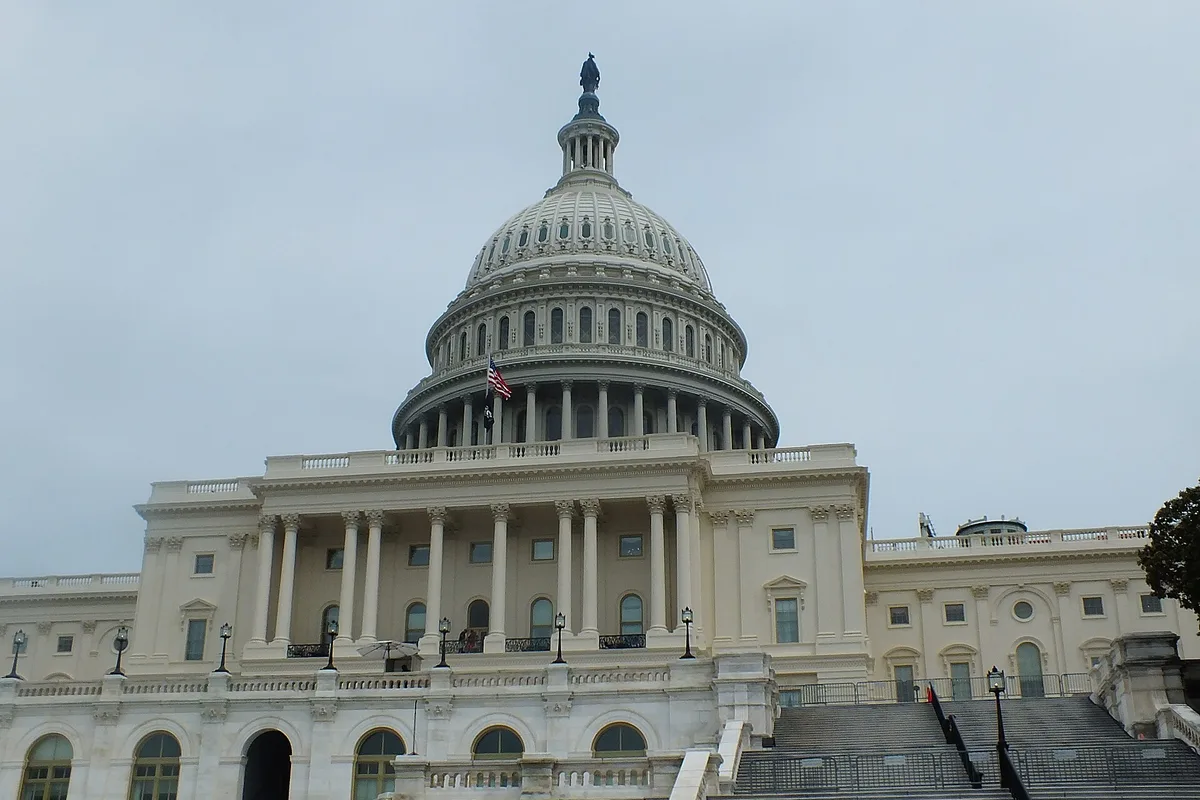
Hero photo: the United States Capitol in Washington, D.C., photographed 3 May 2024 by AramilFeraxa, CC BY 4.0 (via Wikimedia Commons), cropped to 1200x800. Source: https://commons.wikimedia.org/wiki/File:United_States_Capitol_(2024).jpg — no logos or watermarks. Updated 27 November 2026.
Share this article