Straw Constructor STEM Kit 600pcs India Review: Big Builds?
By My Quick Trippers · 21 Oct 2026
7 min read · Travel Gear
Recommended gear
Straw Constructor STEM Kit — Worth It?
Straw constructor STEM kit 600pcs
Check straw-to-connector ratio
As an Amazon Associate, we earn from qualifying purchases. We may earn a commission if you buy through these links, at no extra cost to you.
Honest verdict
for children aged four and up who like building, and especially for classrooms, playgroups, and siblings who build together, a straw constructor is a strong buy, and South India toy sales data published in October 2026 showed healthy monthly volumes for straw-style construction sets.
Check Price on AmazonA straw constructor kit is a box of colourful plastic straws and connectors that children join into bridges, towers, houses, and vehicles, and at 600 pieces it is big enough to build something genuinely impressive rather than just a small shape. At a price band of around ₹1,900, a 600-piece set costs less than most branded building sets, and it covers the one thing those sets do not: large, collaborative structures that two or three children build together. Treat the price band of around ₹1,900 as approximate — sale prices and seller changes move it either way. My verdict: for children aged four and up who like building, and especially for classrooms, playgroups, and siblings who build together, a straw constructor is a strong buy, and South India toy sales data published in October 2026 showed healthy monthly volumes for straw-style construction sets. For solo players who prefer detailed small models, it is less ideal. If you are setting up the playroom as well as the toy shelf, our star projector night lamp review covers the bedtime side of the same room.
What a straw constructor actually is
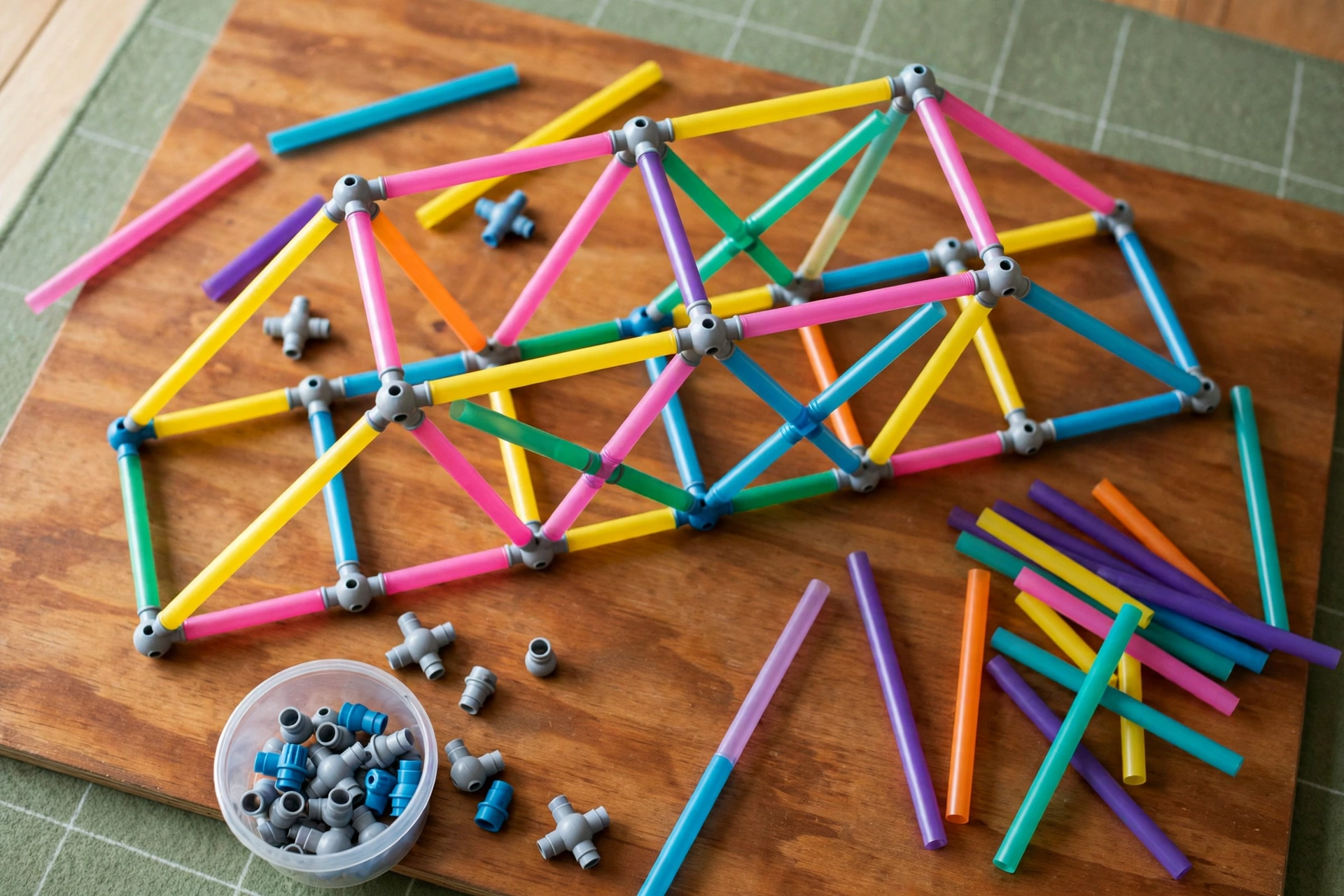
The kit contains plastic straws in several lengths and colours, plus small connectors that join straws at angles, and children push straws into connectors to make frames, which they then fill, extend, and decorate. Unlike blocks, which stack, straw constructors build skeletons: a bridge is a frame of triangles, a tower is a frame of squares stacked upward, and a house is a frame with walls added. That frame-first logic is why these kits are classed as STEM toys, because children learn structural thinking directly: triangles hold, squares wobble, wide bases stand, narrow bases fall. The straws are light and safe, the connectors are simple to use, and the builds can be taken apart and rebuilt endlessly, which means the kit never runs out of play the way a single-model kit does. For teachers and parents, the kit is also easy to demonstrate: build one bridge together, and the child understands the system.
Why 600 pieces matters — and when it does not
Piece count decides what you can actually build, and 600 pieces is the threshold where big builds become possible: a bridge that spans a table, a tower taller than the child, a house with rooms, or a vehicle with a proper frame. Smaller sets of one or two hundred pieces build small shapes well, but they run out before a child's ambition does, and that frustration is the most common reason small construction sets get abandoned. Six hundred pieces also supports group play, because three children can each build a section and join them, which is how classrooms use these kits. The downside of a big count is storage and sorting: six hundred straws and connectors need a box, a bag, or a sorting tray, or they become a floor covering. If you buy the big set, buy the storage with it, or at least dedicate a box from day one, because a kit that cannot be tidied does not get played with twice.
What kids actually learn
Straw constructors teach structural engineering by play: children discover that triangles are rigid, that a wide base supports a tall tower, and that a bridge needs diagonal bracing, all through building and watching things fall. They teach counting and patterning, because children count straws, sort colours, and repeat patterns to make walls and roofs. They teach planning, because a big build needs a plan, even a rough one, and children who plan build bigger than children who improvise entirely. They teach persistence, because a collapsing tower has to be rebuilt differently, not just rebuilt, and that difference is the lesson. They teach collaboration, because big builds need more hands than one child has, and negotiating who builds which part is a social skill in itself. None of this feels like school, which is why children keep playing long after the novelty of a new toy usually fades.
Pros
What it does well
The first win is the price band of around ₹1,900, which buys six hundred pieces for less than most branded sets charge for a hundred. The second win is open-ended play: there is no single model to finish, so the kit never ends, and children rebuild it differently every time. The third win is group play, because the kit is big enough for siblings and friends to build together without fighting over pieces. The fourth win is safety and simplicity: light plastic straws, simple connectors, no batteries, no screens, and no small parts that break off in normal play for children over the recommended age. For classrooms, playgroups, and families with more than one builder, a straw constructor is one of the best-value construction toys available.
Cons
Where it falls short — the honest cons
The honest cons start with durability: straws bend, connectors loosen with heavy use, and a well-loved kit will need replacement pieces over time, so the around ₹1,900 set is not a buy-once-forever purchase. The second con is precision: straw builds are wobbly by nature, and children who want exact, detailed models will prefer bricks or magnetic tiles, which hold shapes more rigidly. The third con is the mess: six hundred pieces spread across a floor is a lot of tidying, and families without a storage system will resent the kit. The fourth con is the age floor: very young children struggle to push straws firmly into connectors, so the kit suits four and up better than three and under, despite what some listings claim. None of these are deal-breakers, but they are reasons to buy the kit for the right child and the right room.
Storage and lost pieces — the practical guide
Storage decides whether a 600-piece kit gets played with or gets shoved in a cupboard. Sort straws by length in separate bags or compartments, keep connectors in their own box, and keep the whole kit in one large container that the child can carry to the building spot. Count the pieces roughly when tidying, not exactly, because the goal is to notice when a whole length is missing, not to audit every straw. Replace lost connectors first, because connectors are the bottleneck: a kit with straws but no connectors builds nothing. If the kit comes without storage, a craft box or a zip bag set costs very little and saves hours of sorting later. The habit to teach is simple: build, play, tidy into the box, and the kit stays usable for years instead of months.
Buying checklist before you order
Check five things before you pay. One, the piece count and the straw-to-connector ratio, because a kit heavy on straws and light on connectors frustrates builders. Two, the straw lengths, because a mix of lengths builds more interesting structures than a single length. Three, the connector quality, because loose connectors make wobbly builds. Four, the age recommendation against your child's hand strength, because pushing straws in firmly needs some grip. Five, storage, because a 600-piece kit without a box is a floor problem waiting to happen. If all five check out, a straw constructor STEM kit at a price band of around ₹1,900 is a sensible, low-regret purchase that buys big, collaborative, screen-free building. If your child prefers small detailed models, buy bricks or tiles instead.
Share this article