Valley of Flowers Trek: Best Time, Route & Permits
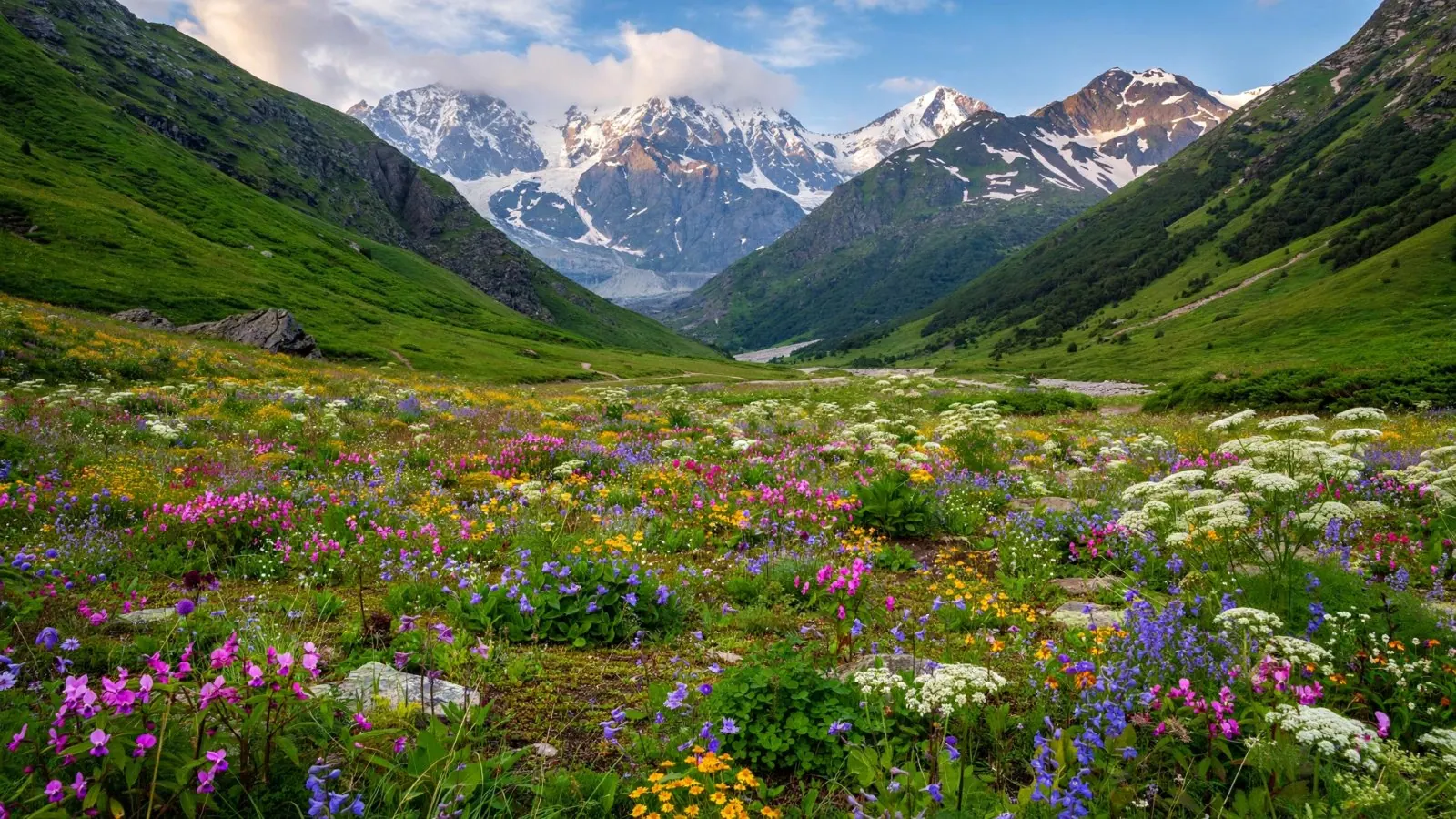
The Valley of Flowers trek leads into a UNESCO World Heritage valley in Uttarakhand's Chamoli district that, for a few monsoon weeks each year, erupts into one of the most spectacular wildflower displays on Earth — hundreds of species carpeting a high glacial valley beneath the Zanskar ranges. It is India's most famous monsoon trek, and entirely unlike the dry-season Himalayan routes.
This guide covers the Valley of Flowers route via Govindghat and Ghangaria, the best time to see the blooms, permits and entry rules, the Hemkund Sahib combination, difficulty and fitness needs, what to pack for a monsoon trek, and a practical 5-6 day itinerary.
The Valley: What Makes It Extraordinary
The Valley of Flowers National Park — part of the Nanda Devi Biosphere Reserve and a UNESCO World Heritage Site — sits at 3,200-4,500 metres, a hanging valley where Himalayan, European and Central Asian flora collide. From mid-July to mid-September, the valley floor becomes a living carpet: blue poppies, cobra lilies, Himalayan bellflowers, geraniums, marsh marigolds and hundreds more, changing week by week. The backdrop — the Rataban, Ghori Parbat and Nilgiri ranges — is as dramatic as the flowers.
The valley's mythology runs deep: locals believe it is the playground of fairies, and the Ramayana associates it with the Sanjeevani herb Hanuman carried. Whether or not you credit the legends, walking through waist-high flowers with snow peaks above is an experience that recalibrates what you expect from a trek.
The Route: Govindghat to Ghangaria to the Valley
The trek has three stages. Govindghat (1,828 m), on the Badrinath road, is the road-head. From here, a 13-14 km trek climbs to Ghangaria (3,050 m) — the base village with the valley's only accommodation, taking 5-7 hours. The trail follows the Pushpawati river through forest, past waterfalls, with dhabas en route. Start by 6-7 AM; mules and porters are available.
From Ghangaria, the Valley of Flowers is a 4 km (one way) day trek — entry at the park gate with permits, a gentle 2-hour walk into the valley proper, then free exploration along the marked trails. No overnight stays are allowed inside the park; you must return to Ghangaria by the gate's closing time. Hemkund Sahib, the Sikh shrine at 4,329 m, is a separate 6 km steep trek from Ghangaria — most trekkers dedicate one day to each.
Best Time: Timing the Blooms
The park opens roughly June to October, but the flowers peak from mid-July to mid-September — this is the window the trek exists for. Early July brings the first blooms (and the heaviest rain); late July through August is peak flower season with the valley at its most riotous; early-to-mid September offers fewer flowers but clearer skies, golden light and thinner crowds.
June is too early (snow patches, few flowers) and late September-October too late (blooms over, though the autumn colours are lovely). The monsoon timing is non-negotiable — this is a rain trek, and you must embrace that: full rain gear, waterproofed everything, and the understanding that downpours are part of the experience.
Permits and Park Rules
Entry permits for the Valley of Flowers National Park are issued at the Ghangaria check post — carry photo ID, and register with your details. A nominal entry fee applies; camera fees may apply for professional equipment. Key rules: no overnight stays inside the park, no picking flowers (strictly enforced — this is a protected biosphere), stay on marked trails, carry out all waste, and return before the gate closes (typically mid-afternoon for entries).
Hemkund Sahib needs no separate permit — it is a religious shrine managed by its trust, open roughly June to October. The 6 km trek from Ghangaria is steep (1,100 m gain) with stairs for much of the way; start by 5-6 AM to return comfortably.
Difficulty, Fitness and Packing for a Monsoon Trek
- Difficulty: moderate — the Ghangaria climb is long but on a clear pilgrim trail; the valley walk is easy; Hemkund is steep and demanding. Reasonable fitness suffices; altitude (3,000-4,300 m) is the main challenge.
- Fitness prep: 3-4 weeks of walking 5-8 km daily plus stair sessions. The Ghangaria day is the filter — train for it.
- Rain gear: full waterproof jacket AND pants, pack rain cover, dry bags inside the pack — everything will get wet otherwise.
- Footwear: waterproof trekking shoes with aggressive grip; the trail is slippery. Carry an extra pair of socks per day.
- Layers: fleece, thermals for Ghangaria nights (cold even in August), quick-dry clothing — no cotton.
- Essentials: headlamp, water bottle, energy snacks, basic medicines, power bank, cash (no ATMs beyond Govindghat), ID for permits.
5-Day Valley of Flowers Itinerary
- Day 1: Drive Haridwar/Rishikesh to Govindghat via Devprayag, Srinagar and Joshimath (long day, 10-11 hours). Overnight Govindghat.
- Day 2: Trek Govindghat to Ghangaria (13-14 km, 5-7 hours). Rest and acclimatise. Overnight Ghangaria.
- Day 3: Valley of Flowers day trek (4 km in, explore, return). Overnight Ghangaria.
- Day 4: Hemkund Sahib trek (6 km steep, 4,329 m) and return. Overnight Ghangaria.
- Day 5: Trek down to Govindghat, drive to Joshimath or Pipalkoti. Overnight halt.
- Day 6: Drive back to Haridwar/Rishikesh. Buffer day recommended for mountain road delays.
What Blooms When: The Flower Calendar
The valley's display changes week by week through the season. Early July brings the first pioneers — marsh marigolds, Himalayan geraniums, and the dramatic cobra lilies. Late July through August is peak diversity: blue poppies (the legendary Himalayan blue poppy), bellflowers, potentillas, asters, and hundreds more in full riot. September shifts to seed heads and autumn golds, with gentians and late asters providing the finale.
The Brahma Kamal — the legendary night-blooming flower of Himalayan lore — grows on the valley's higher slopes and around Hemkund; spotting one is a trekker's badge of honour. Carry a flower guidebook or download a Himalayan flora app — identifying the blooms transforms the walk from pretty to profound. And remember the iron rule: look, photograph, but never pick — the valley's protection depends on every visitor.
Are guides available at Ghangaria?
Yes — local guides and porters are available at Govindghat and Ghangaria, and a guide enriches the valley walk enormously with flower identification and route knowledge. For the standard valley day-trek, guides are optional (the trail is clear); for a deeper botanical experience, hire one.
Frequently Asked Questions
Can beginners do the Valley of Flowers trek?
Yes — it is one of the best beginner Himalayan treks. The trails are clear and busy, the distances are manageable, and no technical skills are needed. The monsoon rain and the Ghangaria climb's length are the main challenges; basic fitness preparation handles both.
Is it safe to trek in the monsoon?
The Valley of Flowers exists because of the monsoon — this is a rain trek by design. The trails are maintained pilgrim routes, not remote wilderness. That said, respect mountain monsoon: start early, carry full rain gear, watch for slippery sections, and follow local advice on heavy-rain days.
Can I stay inside the Valley of Flowers?
No — overnight stays inside the national park are prohibited. All trekkers base at Ghangaria and do the valley as a day trek, returning before the gate closes. This protects the fragile ecosystem.
Should I combine it with Hemkund Sahib?
Absolutely — it is right there, 6 km from Ghangaria, and the combination is the classic itinerary. The Hemkund trek is steeper and needs an early start, but the high-altitude lake and gurudwara at 4,329 m are unforgettable. Budget one full day for it.
What wildlife might I see?
The park is home to snow leopards, Himalayan black bears, blue sheep and musk deer — sightings are rare and lucky. More reliably: Himalayan monals, koklass pheasants and a wealth of butterflies among the flowers. The flora is the guaranteed spectacle.
The Valley of Flowers is the Himalayas' great monsoon secret — rain, flowers, peaks and mythology in one valley. Time it for late July to early September, pack for rain, and walk slowly: the valley rewards those who look closely. To plan the trek with stays, permits and transfers, chat with our travel experts on WhatsApp to plan this trip.
Share this article