Nag Tibba Winter Trek Guide: A 2-Day Snow Trek From Pantwari
By My Quick Trippers · 29 Oct 2026
5 min read · Mountains & Adventure
Nag Tibba is the winter trek for people who cannot take a week off. At 3,022 metres (9,915 feet), it is the highest peak of the Nag Tibba range in the Lesser Himalaya, a two-day, one-night trek from the village of Pantwari in Tehri Garhwal — close enough to Dehradun for a weekend, high enough for real snow in winter, and easy enough for a first trekker with basic fitness. It is also the trek the Delhi weekend crowd is discovering right now, which is why this guide exists: a straight account of the route, the winter season, and what to honestly expect from the snow. No price is quoted here — Nag Tibba treks run through operators and local guides, and fees vary by season, so confirm the current fee with your operator before booking. And no snowfall is guaranteed on any date: December to February is the snow season, not a snow promise.
Last verified: 29 October 2026. Route figures below were checked against multiple 2026 trek guides on that date; operators differ slightly in daily distances, and the ranges below reflect that variation rather than hiding it. The summit name means Serpent's Peak, and a temple to Nag Devta stands near the top, where local villagers have worshipped for centuries.
The trek at a glance
- Summit: 3,022 metres (9,915 feet), the highest point of the Nag Tibba range.
- Base village: Pantwari, in Tehri Garhwal, about 85 kilometres from Dehradun — roughly 3.5 to 4.5 hours by road via Mussoorie and Nainbagh.
- Distance: about 16 kilometres round trip on the standard Pantwari route, with some operators quoting up to 20 kilometres depending on the exact trail and camp.
- Duration: 2 days and 1 night for most trekkers; experienced walkers sometimes push it into a single long day, which is not recommended for a first winter trek.
- Difficulty: easy to moderate — steady climbing, no technical sections, but winter snow and cold raise the effort well above a summer walk.
- Snow season: December to February, with the best snow odds in late January and early February. The trek runs year-round, but winter is the reason to choose it.
The route, day by day
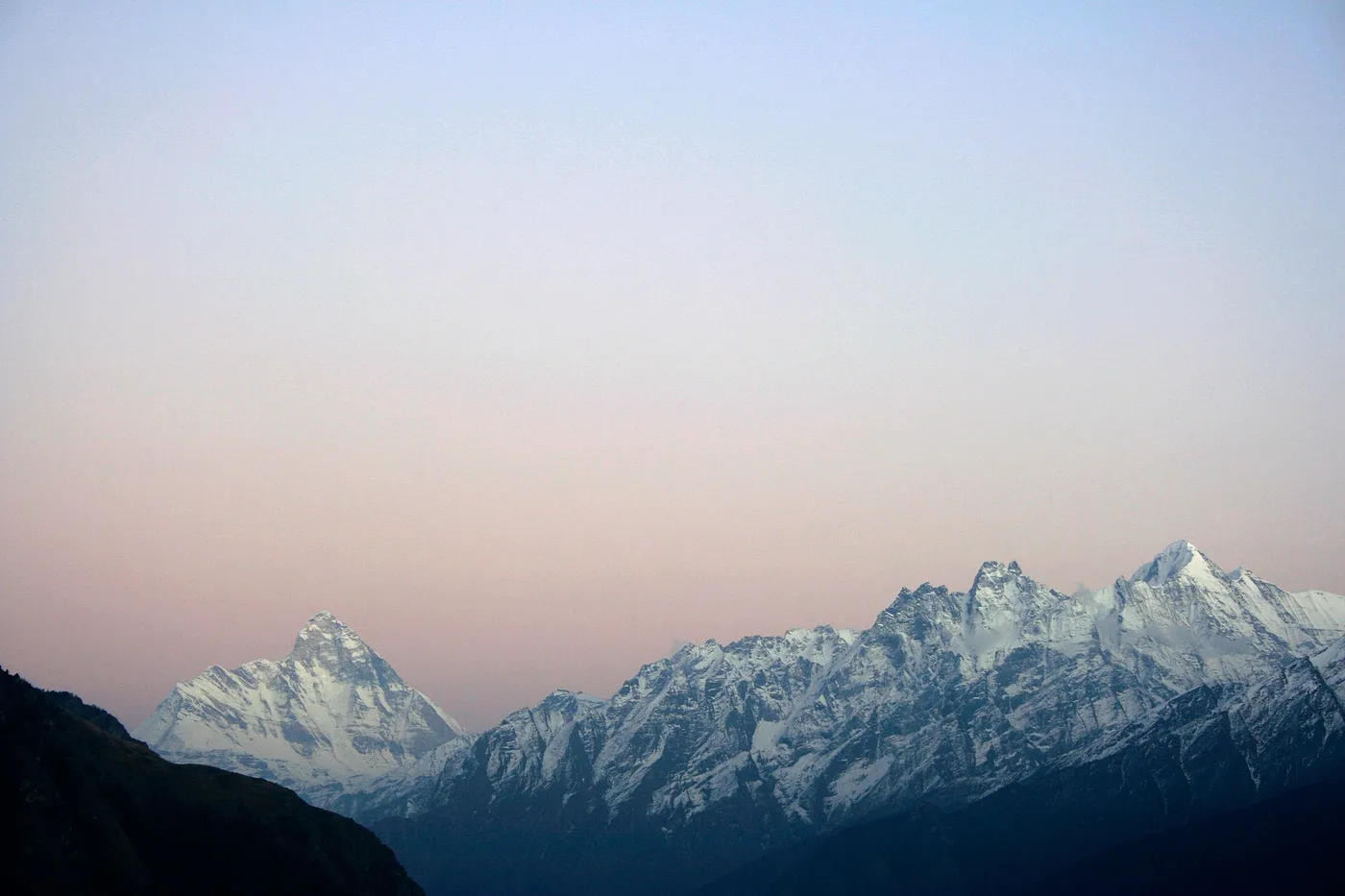
Day one starts with the drive from Dehradun to Pantwari, then the climb: roughly 4 to 4.5 kilometres from Pantwari to the base camp through oak, rhododendron and deodar forest, past shepherd huts and terraced fields. Camp sits below the ridge, and winter nights there are genuinely cold — this is the night your sleeping bag and layers earn their place. Day two climbs the remaining 3.5 to 4 kilometres to the summit ridge and the Nag Devta temple, then descends all the way back to Pantwari. On a clear day the summit view runs across Bandarpoonch, Swargarohini, Srikanth, Black Peak and the Gangotri group — the classic Garhwal panorama, and the reason a two-day trek punches so far above its weight.
Winter on Nag Tibba: what to actually expect
Winter transforms the trek without making it dangerous for a prepared walker. The trail from Pantwari is a steady forest climb, not a scramble, but snow on the upper section changes the footing: microspikes or good grip help, and a local guide is strongly recommended in snow conditions, both for route-finding and for judging whether the summit ridge is safe on the day. Temperatures at camp in deep winter sit below freezing at night, and the summit wind is colder still. This is a trek where clothing is safety equipment: thermal base, fleece, windproof shell, gloves, warm cap, and waterproof boots with grip. Operators run the trek through the season, and the honest crowd note applies here too — Nag Tibba is popular precisely because it is short, which means winter weekends can be busy. A weekday start, or an early start on the trail, buys you the quiet version.
Getting to Pantwari
Most trekkers start from Dehradun, which has the nearest airport and railway station. The road runs Dehradun to Mussoorie, then via Nainbagh to Pantwari — about 85 kilometres and 3.5 to 4.5 hours depending on traffic around Mussoorie. Public buses run from Dehradun toward Nainbagh, where shared jeeps continue to Pantwari; a taxi from Dehradun is simpler and lets you start the trek the same day. Start early: the Mussoorie stretch congests by late morning, and arriving in Pantwari with daylight to spare makes the first climb far more pleasant.
What to pack for a winter weekend trek
Winter packing for Nag Tibba is standard winter-trek kit, not expedition gear: thermal base layer, fleece, windproof outer shell, warm cap and gloves, waterproof boots with grip, and a sleeping bag rated for sub-zero nights if you are camping. Carry water and snacks for the trail — there are no shops above Pantwari — and sun protection for the summit ridge, where winter sun on snow is stronger than it looks. Microspikes are worth carrying in deep winter if your operator recommends them; they are cheap insurance on an icy upper trail.
How Nag Tibba compares
Against the bigger winter treks, Nag Tibba is the short, sharp alternative: Kedarkantha and Brahmatal are six-day commitments with higher summits and deeper snow, while Nag Tibba is a weekend with a genuine summit and a genuine Himalayan panorama. That is its appeal and its limit — it will not give you the high-pass experience of a longer trek, and it should not be sold as one. For a Delhi or Dehradun traveller with one weekend, it is the best first snow trek in the Garhwal; for a traveller with a week, it is the warm-up, not the main event. Our winter trek guides to Kedarkantha and Brahmatal cover the longer options, and our companion batch pages on Dayara Bugyal and Kuari Pass cover the other quieter alternatives. If you want Nag Tibba shaped around your weekend — operator, dates and snow-week advice — talk to the My Quick Trippers team via our contact page.
Share this article