Wall-Mounted Phone Holder India Review: Free Your Kitchen Counter?
By My Quick Trippers · 21 Oct 2026
7 min read · Travel Gear
Recommended gear
Wall-Mounted Phone Holder — Worth It?
Wall-mounted phone holder stand
Frees counter space; confirm mounting method and weight limit
As an Amazon Associate, we earn from qualifying purchases. We may earn a commission if you buy through these links, at no extra cost to you.
Honest verdict
for small kitchens, bathrooms and bedside charging corners, it is a clever, cheap fix that frees counter space and keeps the phone visible and charging.
Check Price on AmazonEvery small kitchen has the same problem: the phone with the recipe on it has nowhere to go. The counter is wet, the shelf is full, and the phone ends up balanced against a jar where one splash ruins it. The wall-mounted phone holder stand solves that problem by moving the phone off the counter entirely, priced at around ₹84–189 across Amazon India storefront listings, where several holders sit among the best-seller-adjacent listings in mobile accessories. My verdict: for small kitchens, bathrooms and bedside charging corners, it is a clever, cheap fix that frees counter space and keeps the phone visible and charging. For renters who cannot drill and heavy-tablet users, the mounting method and weight limit decide whether it works at all.
What a wall-mounted holder actually is
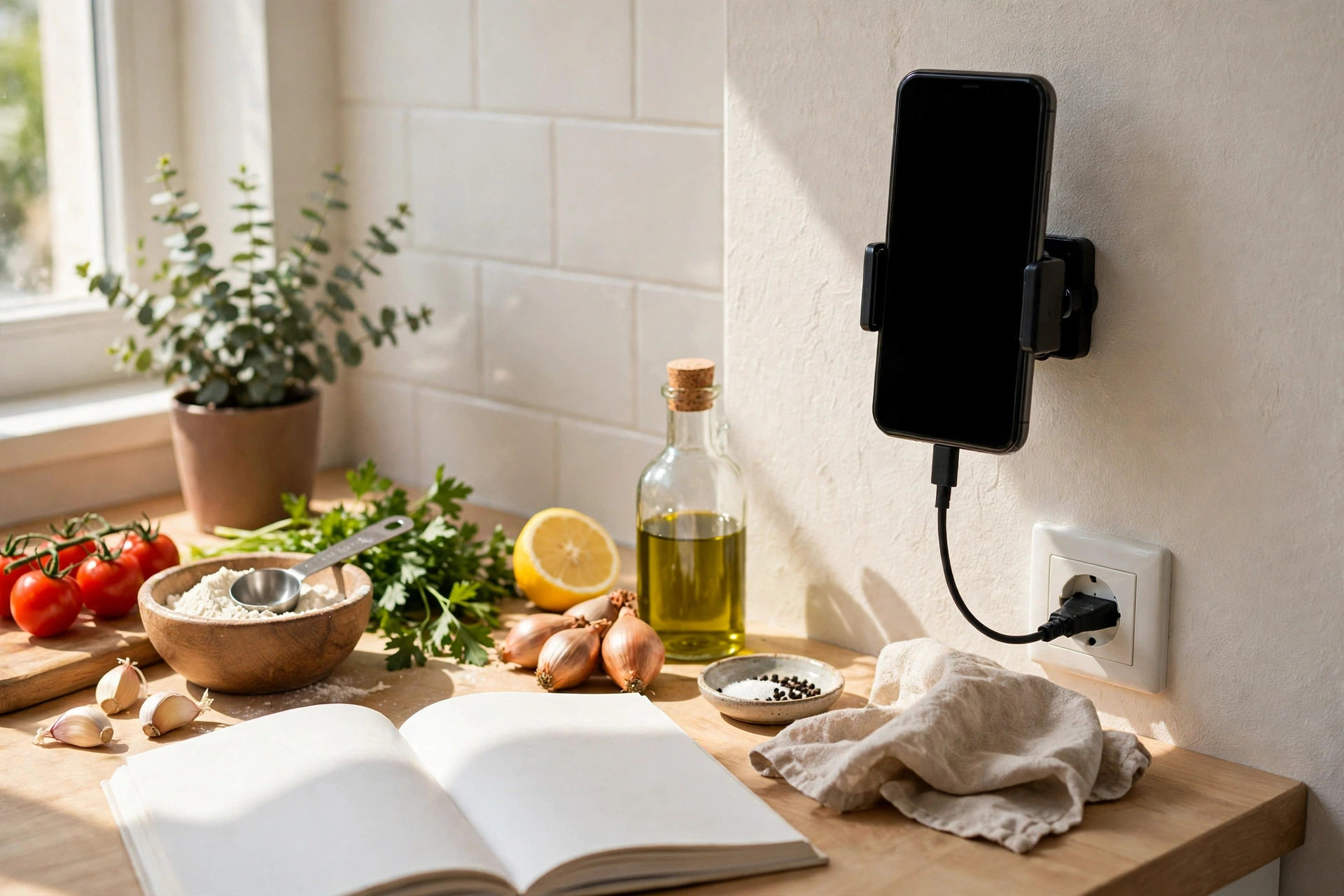
A wall-mounted phone holder is a small cradle or shelf that fixes to a wall — by adhesive, by screws, or by both — and holds a phone at eye level near a socket, usually with a cable routed to the charger. The point is not storage; it is placement. A phone on a wall mount stays visible while you cook, stays dry away from the sink, stays out of the way of the cutting board, and stays charging while you use it. That combination is what makes it different from a desk stand, which occupies counter space, and from a phone lying flat, which occupies counter space and invites splashes. The holder's job is to give the phone a home on the wall, and in a small Indian kitchen where counter space is the scarcest resource, that home is worth more than the holder's tiny price.
Pros
What it does well
The first win is counter space. Moving the phone to the wall frees the exact square of counter where recipes, chopping and plating happen, and in a small kitchen that square matters more than any gadget. The second win is visibility while charging: the phone sits at eye level near the socket, so the recipe stays readable and the phone charges at the same time, instead of lying flat somewhere with a cable stretched across the counter. The third win is protection from the kitchen's two enemies: water and heat. A wall-mounted phone stays away from splashes, steam and hot pans in a way a counter phone does not. The fourth win is the price band of around ₹84–189, which makes it a zero-regret experiment for any small space — kitchen, bathroom, bedside or study corner — where a phone needs a home that is not a flat surface.
Cons
Where it falls short — the honest cons
First, the mounting method is everything, and it is also the main risk. Adhesive mounts are renter-friendly but depend on the wall surface: they grip smooth tiles well and struggle on rough plaster, textured paint or damp walls, and a failed adhesive drops the phone. Screw mounts hold far more weight but need drilling, which many rentals forbid. Before ordering, decide which method your wall and your landlord allow, and check the holder's stated weight limit against your phone plus its case. Second, placement is permanent in a way a desk stand is not: once it is on the wall, moving it leaves marks or requires a new adhesive pad, so choose the spot carefully — near a socket, at a readable height, away from direct steam. Third, most wall holders are phone-sized, not tablet-sized, so a heavy tablet can overwhelm them; check the weight limit rather than assuming. Fourth, cable routing needs a plan: the socket must be close, or the cable dangles across the wall, which looks worse than the problem it solves.
Wall mount vs desk stand vs lying flat
The honest comparison starts with lying flat, which costs nothing and risks everything: splashes, scratches, a cable across the counter and a phone nobody can read while cooking. A desk stand fixes readability but still occupies counter space, which is the resource a small kitchen lacks. A wall mount fixes both readability and counter space, at the cost of permanence and mounting effort. For a kitchen, that trade is usually worth it. For a desk, where counter space is less scarce and the phone moves constantly, a desk stand wins on flexibility. For a bedside, either works, and the wall mount wins only if the bedside table is already full. Buy the mount for the room where space is scarcest, not for every room at once.
Who should buy it — and who should skip it
Buy it if your kitchen counter is small, if you follow recipes on your phone, if your bathroom or bedside needs a charging spot that is not a flat surface, or if you are setting up a small home and want every surface to earn its keep. It is also a good pick for hostels and PG rooms, where a wall mount creates a charging corner without furniture. Skip it if you rent and cannot use adhesive or screws on your walls, if your phone is very heavy in a bulky case and the weight limit is unclear, or if you need a tablet holder — buy a tablet-rated mount instead. Skip it too if your sockets are far from any usable wall spot, since a dangling cable defeats the tidiness the mount is for.
Buying checklist before you order
Confirm the mounting method against your wall type and rental rules, and confirm the weight limit against your phone plus case. Choose the spot before ordering: near a socket, at a readable height, away from direct steam and splashes. Check reviews for adhesive failures on your wall type specifically, not just overall ratings. Confirm the holder fits your phone size with its case on, and check whether spare adhesive pads are included for repositioning. Treat the price band of around ₹84–189 as approximate: adhesive and screw-mount versions sit at different ends of it, and the cheapest listing is rarely the sturdiest. For the same organise-the-kitchen logic applied to cooking tools, our AGARO Delite chopper review covers the gadget that earns its counter space the same way.
Renters: adhesive done right
Adhesive mounts fail for predictable reasons, and nearly all of them are preventable with ten minutes of preparation. The first reason is surface: adhesive grips smooth tiles, glass and glossy laminates well, and struggles on rough plaster, textured paint, dusty walls and damp bathroom tiles. Clean the spot first with a dry cloth, and if the wall is dusty or greasy, wipe it and let it dry completely before sticking anything, since adhesive bonds to the dust, not the wall, when the surface is dirty. The second reason is weight: a phone plus a heavy case plus a charging cable can exceed a cheap holder's limit, so check the rating and test with the phone in its case, not the bare phone. The third reason is impatience: adhesive needs hours to cure before it bears weight, and loading it immediately is the most common cause of a midnight fall.
Stick it in the evening, load it in the morning, and it holds far better. The fourth reason is removal: when moving out, warm the adhesive gently with a hair dryer and peel slowly, which removes most residue without tearing paint, and keep the spare adhesive pads the holder shipped with for the next flat. Done this way, an adhesive mount is a renter's friend rather than a landlord dispute, and the phone gets its wall home without a single hole.
The bottom line
The wall-mounted phone holder earns its place as the smallest space-saving purchase in this batch: a phone off the counter, visible while cooking, charging while you work, for less than the cost of a meal. It demands one careful decision — the mounting method and the spot — and rewards it every day after. Put it where the recipe is read and the socket is near, and the kitchen gets its counter back.
Share this article